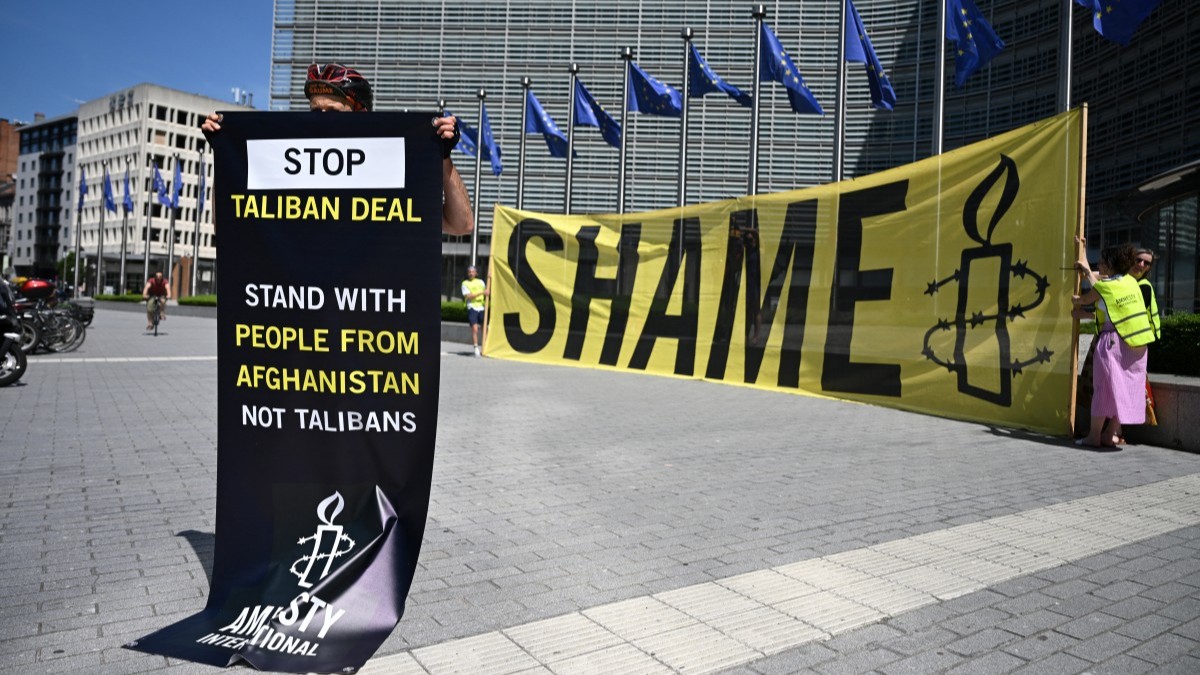
An Amnesty International activist hold a banner reading “Stop Taliban deal” in front of the EU Commission headquarters to protest against a meeting with a Taliban delegation in Brussels on June 23, 2026.
NICOLAS TUCAT / AFP
For the first time since the fall of Kabul in 2021, representatives of the Taliban regime have been received in Brussels for talks with European officials.
The meeting, held behind closed doors on Tuesday, marks a step that would have been difficult to imagine within EU institutions just a few years ago.
The Afghan delegation arrived in Belgium on five visas with exceptionally limited validity. Belgian authorities authorized their entry only for Belgian territory and only for a single day, an unusual arrangement that reflects the political sensitivity surrounding the meeting.
Officially, the talks were strictly technical in nature. According to the European Commission, EU officials and representatives from fifteen member states took part in discussions focused on the return and readmission of Afghan nationals who have no legal right to remain in the European Union.
The meeting followed earlier contacts held in Kabul in recent months. Yet the political symbolism is difficult to ignore.
The Commission itself has insisted that the meeting does not constitute diplomatic recognition of the Taliban regime. In fact, the European Union still does not officially recognize the government established by the Islamists after their return to power and continues to maintain sanctions against numerous members of the organization.
Even so, Brussels went to great lengths to avoid publicizing the encounter. There were no official photographs, no joint press appearances, and no visible events that could project an image of institutional normalization.
The extreme discretion with which the visit was organized reveals the extent to which European institutions are aware of the political contradiction involved in receiving representatives of a regime they have spent years condemning for serious violations of fundamental rights.
The need to facilitate deportations appears to have outweighed other considerations. Realpolitik.
Migration pressures have led several European governments to demand more effective mechanisms for returning rejected asylum seekers and immigrants convicted of serious crimes. The problem for Brussels is that such deportations become extremely difficult when there are no operational channels with the authorities that effectively control the destination country.
Nevertheless, the meeting triggered an immediate political backlash. Green MEP Hannah Neumann warned that every official invitation and every visa issued sends a political signal that the Taliban can use to strengthen their international legitimacy.
Several NGOs, including Human Rights Watch and Amnesty International, also questioned the decision and warned of the risks of cooperating with a regime accused of systematically restricting women’s rights, banning girls from secondary education, and curtailing broad civil liberties—precisely the values Brussels says it defends when it suits its interests.
For now, Brussels is trying to maintain a balance between these competing positions. But Tuesday’s visit shows that when migration enters the equation, political red lines that once appeared immovable can begin to shift. The so-called Overton window moves under the pressure of reality.