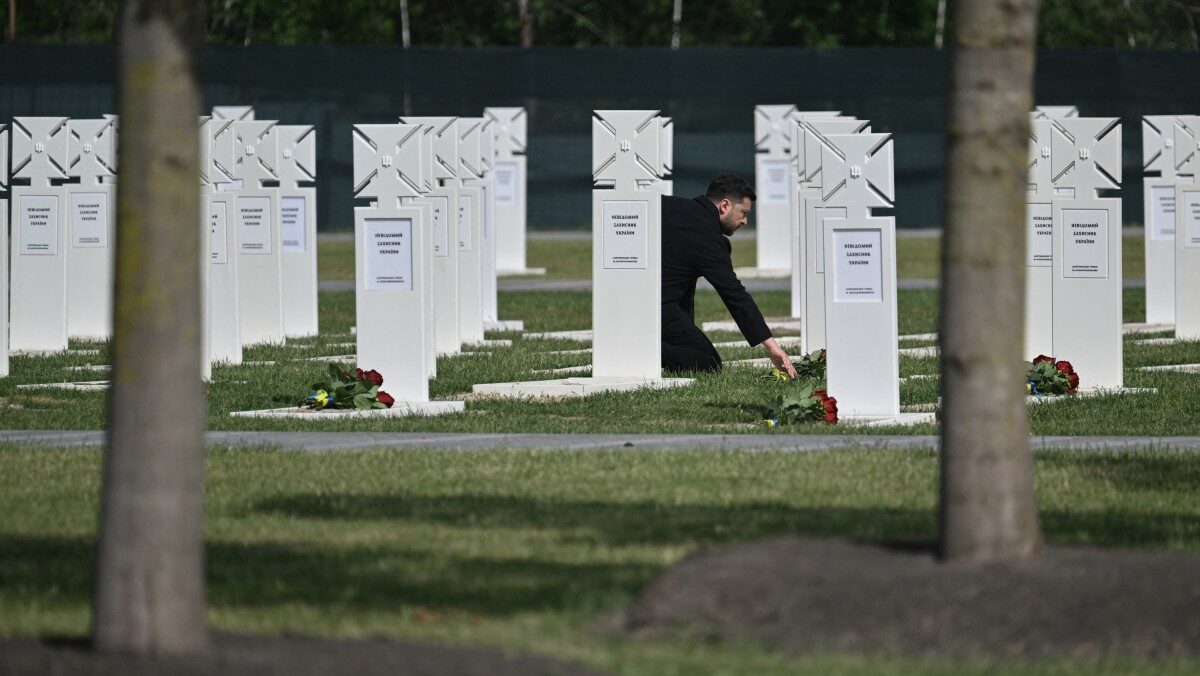
Ukraine’s President Volodymyr Zelensky lays flowers at the grave of a fallen Ukrainian soldier during a ceremony at the National Military Memorial Cemetery near Kyiv on May 25, 2026.
GENYA SAVILOV / AFP
The European Commission has proposed extending the temporary protection regime granted to displaced Ukrainians until March 2028, but with a politically explosive change: newly arriving Ukrainian men of military age who do not have authorization to leave their country would be excluded from that automatic protection.
For now, the restriction would not affect those already covered by the European system. But it would change the entry route for a very specific category of people: Ukrainian men with the legal or potential capacity to fight.
The legal nuance matters. Brussels is not proposing to withdraw status from all Ukrainians across the board, nor to prohibit them from applying for individual asylum.
What it is proposing is to deny them access to the fastest, most stable, and most extensive mechanism the Union activated after Russia’s invasion in 2022: the Temporary Protection Directive, which allows people to reside, work, and access basic services without first going through ordinary asylum procedures.
There are currently more than 4.3 million Ukrainians under this umbrella in the EU.
The shift is what stands out. For more than four years, Brussels presented the reception of Ukrainians as a European moral obligation, a test of continental solidarity, and proof that Ukraine belonged to Europe’s political family.
Now, as the war drags on and Kyiv needs men to prevent a total military collapse, protection begins to distinguish between those fleeing the war and those who, according to the institutional logic, should return to it.
According to the information coming from Brussels itself, the measure responds to Ukraine’s military needs and to Kyiv’s request to stem the departure of men subject to mobilization obligations.
This line had already been under discussion in several member states. Reuters reported that European ministers supported limiting protection for Ukrainian men of fighting age; the most discussed bracket was men aged 23 to 60.
The problem is not only migratory. It is structural and incoherent. The European Union keeps its reception channels open for young men from numerous third countries, including societies where there is no realistic expectation of rapid integration and no comparable European political obligation.
But when it comes to Ukrainian men—citizens of a country Brussels defines as ‘European,’ a candidate for EU membership and a central piece of its strategy against Russia—protection begins to be conditioned on their military usefulness.
The Commission will insist that no one will be automatically expelled and that those affected will be able to file individual asylum applications. That is true. But it is also true that temporary protection is not an administrative detail. It grants immediate residence, access to employment, social assistance, education, and healthcare.
Formally, the right to seek asylum remains. Materially, the shield that made that right viable for millions of people is removed.
That is where the legal doubts appear. The available legal analysis warns of risks under the EU Charter of Fundamental Rights: human dignity, the right to asylum, non-refoulement, equality before the law, non-discrimination on grounds of sex and age, and the proportionality of any limitation of rights. In the eyes of European law itself, excluding Ukrainian men of military age may constitute indirect discrimination and a form of structural pressure to return them to a war environment where they may end up being sent to the front.
The Council of Europe has already warned against any measure that forces premature returns or creates legal uncertainty for displaced Ukrainians, according to Associated Press reporting on the proposal.
That caution is not humanitarian rhetoric. If the EU withdraws rights from a group because that group is militarily useful to another state, protection policy ceases to be guided by the individual’s risk and becomes subordinated to a strategic necessity. And that position changes everything from now on.
Brussels can argue that it supports Ukraine. It can be argued that war requires sacrifices. It can even be argued that member states should not facilitate the evasion of military obligations set by Kyiv. But then it should acknowledge what it is doing: turning a humanitarian tool into an instrument of indirect mobilization.