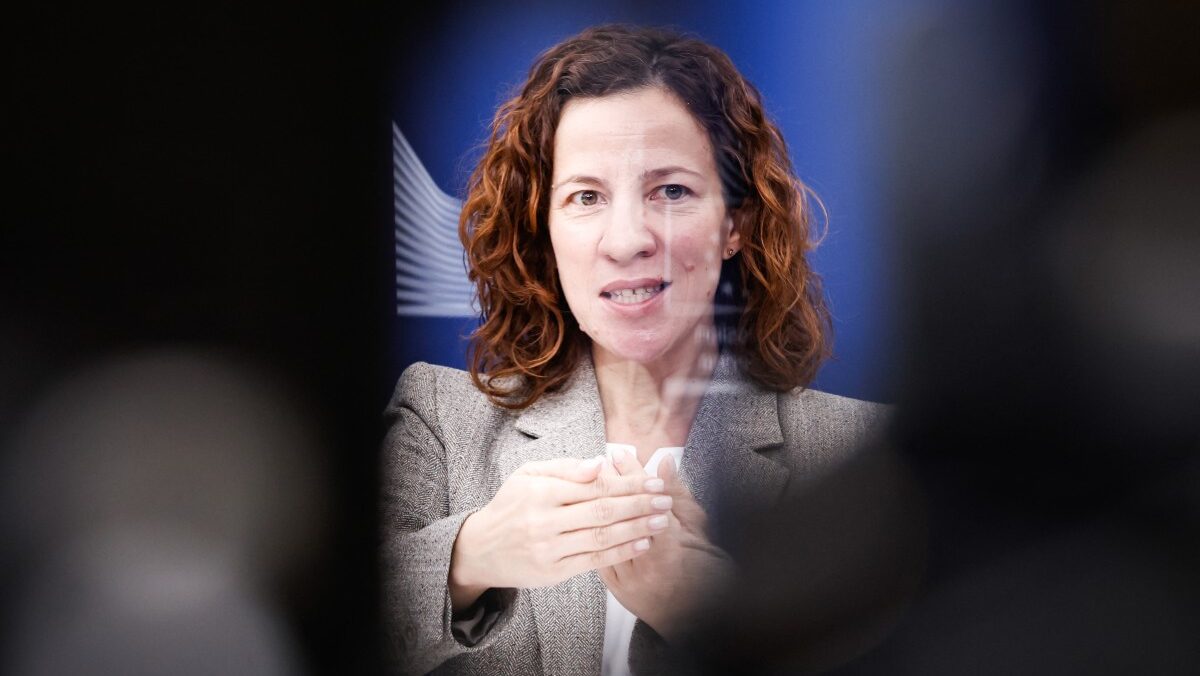
EU Executive Vice-President for Social Rights, and Skills, Quality Jobs and Preparedness Roxana Minzatu gestures as she attends a press conference on the Commission’s response to the European Citizens’ Initiative ‘My Voice, My Choice’ at the EU Headquarters in Brussels, on February 26, 2026.
The Parliamentary Assembly of the Council of Europe (PACE) is facing questions over the shortlist for this year’s Vigdís Prize for Women’s Empowerment after the European abortion-rights campaign ‘My Voice, My Choice’ was named among the three shortlisted candidates for the award.
The prize, organised jointly by PACE and the Government of Iceland, will be awarded on Monday, June 22, during the Assembly’s June part-session in Strasbourg. The winner will be selected by the prize panel the day before. The Vigdís Prize is named after Iceland’s former president Vigdís Finnbogadóttir, the first woman in the world to be elected as head of state. It is intended to recognise initiatives that promote the empowerment of women for the common good in Europe and beyond. For 2026, the shortlist includes three nominees: the Girl Child Counselling Women Group from Kenya, the European Citizen Initiative ‘My Voice, My Choice: For Safe And Accessible Abortion,’ and Sasane Samrakshak Samuha from Nepal.
The inclusion of a European Citizens’ Initiative has now prompted a formal objection from German MP Malte Kaufmann, a member of the Bundestag affiliated with the European Conservatives, Patriots & Affiliates (ECPA) group within PACE, who has written to the members of the Vigdís Prize selection panel led by the Austrian Socialist Petra Bayr, the secretary general of the Council of Europe, and the foreign affairs minister of Iceland. In his letter, dated June 18, 2026, Kaufmann asked the panel not to proceed with the nomination and to remove the initiative from the shortlist.
At the centre of the dispute is the institutional nature of the campaign. ‘My Voice, My Choice’ is often described as an ordinary, normal citizens’ initiative. In everyday language, that may sound like a general civil society campaign to promote the common good. Legally, however, it was a European Citizens’ Initiative under EU law—a specific, legally regulated tool obliging the EU Commission to examine the request and decide whether to propose legislation or explain why it will not.
Kaufmann argues that this distinction matters. In his letter, he writes that ‘My Voice, My Choice’ “is not a citizens’ initiative in the ordinary sense of the term” but “a formal instrument placed at the beginning of a European Union legislative process, provided for under specific articles in the EU Treaties” and their relevant implementation regulations.
‘My Voice My Choice’ was launched by pro-abortion activists and called on the EU Commission to create a specific budget line in the EU budget intended to always have fresh money to facilitate cross-border access to abortion. However, in February 2026, the EU Commission rejected this specific request. Instead, the von der Leyen institution referred to the possibility for member states to use already existing EU instruments, particularly the European Social Fund Plus, on a voluntary basis and in accordance with national law. That distinction is now at the heart of the criticism. Kaufmann argues that the “very core” of the initiative was not accepted by the EU Commission. He also points to the broader question of EU competence, noting that public health policy remains primarily a responsibility of the member states.
The Council of Europe is not an EU institution. It has 46 member states and is primarily concerned with human rights, democracy and the rule of law. That is one reason why the shortlist has attracted attention. Critics say PACE should avoid appearing to endorse a contested EU legislative campaign, especially when the original request for a new dedicated funding mechanism was not granted in the form sought by its organisers.
In his letter, Kaufmann stresses that his objection does not require the Council of Europe to take a formal position on abortion itself. The point, he argues, is whether the Vigdís Prize should give symbolic recognition to an EU campaign that remains politically and legally divisive. “It is not necessary to take a position on abortion itself to observe that the credibility of the Parliamentary Assembly of the Council of Europe, and of the Vigdís Prize, would be weakened by such a choice,” Kaufmann writes. He further argues that women’s empowerment can be understood differently by many Europeans, including through practical support for mothers of all ages, the reconciliation of family and professional life, and the recognition of domestic and family work done by women.
The legal sensitivity of questions concerning the beginning of human life has also been raised in this context. In its 2011 Brüstle judgement C-34/10, the Court of Justice of the European Union dealt with patent law. Even so, the Court held that any human ovum after fertilisation must be regarded as a human embryo, since fertilisation begins the process of development of a human being: human life starts with conception. For critics of the nomination, this illustrates why European institutions should handle such questions with particular care. They argue that the Vigdís Prize should honour initiatives capable of commanding broad support in the promotion of women and the common good, rather than elevating a divisive EU policy campaign that, moreover, failed to obtain its requests.
Kaufmann also invokes the symbolic meaning of the prize itself. “The Vigdís Prize bears the name of a woman who united her country rather than divided it,” he writes, adding that the award should remain “above ideological divisions”. He concludes that removing ‘My Voice, My Choice’ from the shortlist would not damage the prize but protect it. “This would not be a sign of weakness,” he writes, “but would strengthen the credibility of the Vigdís Prize.”
The prize panel is scheduled to meet in Strasbourg on Sunday, 21 June. The awards ceremony will take place the following day at the opening of PACE’s June part-session.