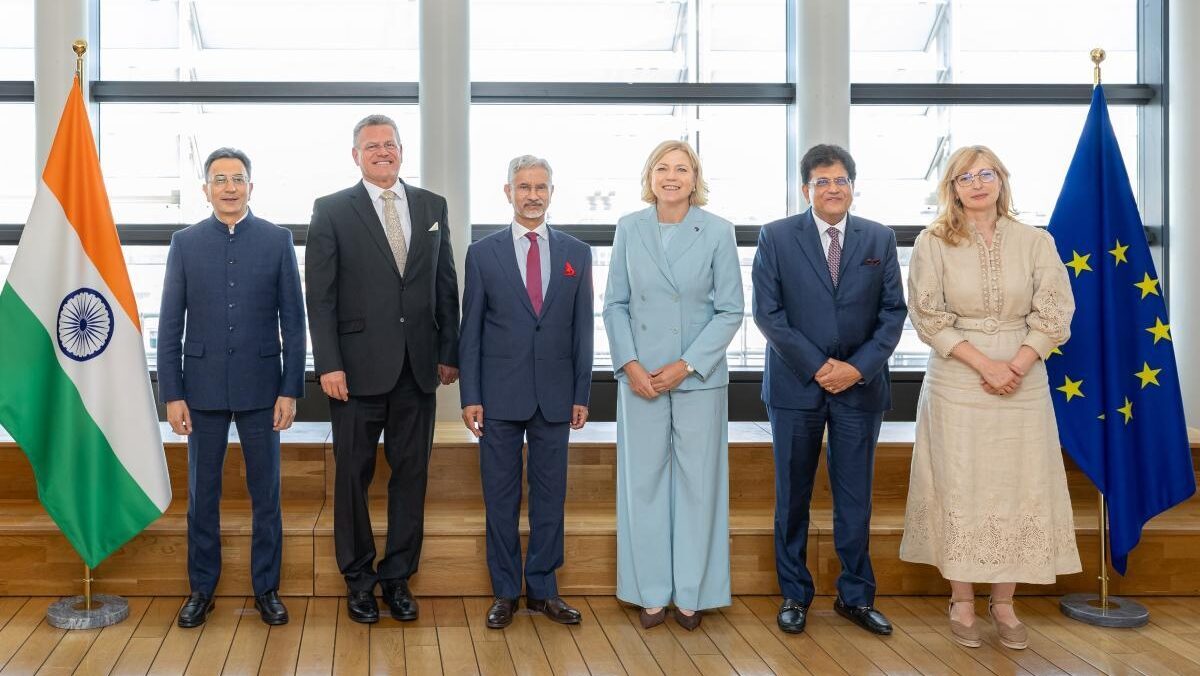
European Commission officials Henna Virkkunen, Maroš Šefčovič and Ekaterina Zaharieva attend the third EU–India Trade and Technology Council meeting in Brussels on July 15, 2026.
EC – Audiovisual Service, Copyright European Union, 2026
The European Union and India agreed on Wednesday to deepen ties on trade and technology, making India only the second country after the United States to have this level of formal partnership with Brussels.
The relationship is not yet comparable to the EU’s ties with Washington, and trade between Europe and India is still much smaller. But the move sends a clear political message: Brussels wants India to play a much bigger role in its supply chains, technology sector and wider economic strategy.
The third meeting of the EU–India Trade and Technology Council took place in Brussels on Wednesday, bringing together three Indian ministers and three members of the European Commission. India was represented by External Affairs Minister Subrahmanyam Jaishankar, Commerce and Industry Minister Piyush Goyal, and Minister of State for Electronics and Information Technology Jitin Prasada. The European delegation was led by Henna Virkkunen, Maroš Šefčovič and Ekaterina Zaharieva.
The council itself is not new. It was launched by European Commission President Ursula von der Leyen and Indian Prime Minister Narendra Modi in 2022. However, both sides agreed on Wednesday to expand its role before the end of the year. It remains India’s only trade and technology council with another country or bloc, while for the EU it is only the second after the one created with the United States in 2021. That alone shows how important Brussels considers its relationship with New Delhi.
The new plans include opening talks on India’s participation in the Horizon Europe research programme, creating a joint centre for electric vehicle charging technology, launching an alliance of high-tech start-ups, and expanding cooperation on semiconductors, artificial intelligence, supercomputers, quantum technology and 6G networks. The two sides also agreed to work more closely on pharmaceutical, food and energy supply chains.
Jaishankar said the partnership was about improving economic security by making production more diverse and markets more predictable. He warned against relying too heavily on a small number of manufacturing centres and called for stronger, more reliable supply chains. Although he did not mention China by name, the message was clear.
Goyal described 2026 as “a historic year” for relations between India and the EU and said the council had become “an important pillar” of the partnership. Šefčovič said a free trade agreement, which both sides hope will take effect in 2027, would be “a real game changer”. Virkkunen said the priority was to develop secure and reliable technologies together.
India still accounts for only 2.3% of the EU’s trade in goods, but trade between the two has grown by almost 84% over the past decade. Brussels is looking beyond today’s trade figures and focusing on India’s growing industrial strength, large population and strategic position as a country that maintains its independence from Washington, Beijing and Moscow.
The EU is betting that India will become one of the main pillars of its future economic strategy. It is one of Brussels’ biggest diplomatic and commercial investments in recent years.
The move also reflects a wider recognition that the global economy can no longer revolve around the transatlantic relationship alone. India is not joining the partnership as a junior ally, but as a major power with interests of its own. How the two sides manage those different interests will shape the future of the relationship.