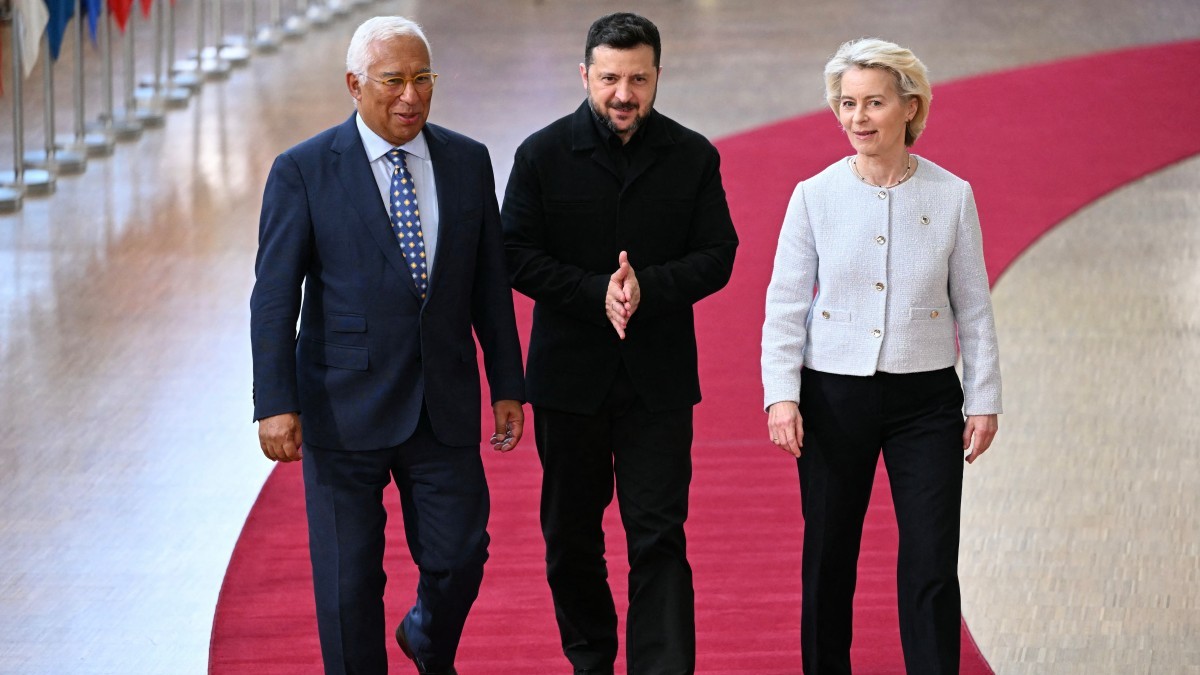
During the European Council summit taking place in Brussels, the 27 EU member states approved conclusions on Thursday welcoming the progress made by Kyiv and the recent opening of the first negotiation cluster, while removing a reference that had appeared in earlier drafts: the opening of additional chapters “as soon as possible.”
Instead, leaders stressed that any further progress must take place “in accordance with the merit-based approach.”
For years, the war transformed Ukraine’s accession to the European Union into a geopolitical issue rather than a technical one. Brussels has now reminded everyone that procedures still exist.
It may sound like a semantic difference. It is not.
Since the beginning of Russia’s invasion, Volodomyr Zelensky has repeatedly advocated a fast-track accession route, arguing that Ukraine is already paying in blood for its place within the European political space. The European Commission was receptive to that narrative and for months encouraged the idea of an extraordinarily rapid integration process.
Ukraine believes that every democratic nation in Europe deserves to be a full member of the EU. And we are working as actively as possible to achieve this.
— Volodymyr Zelenskyy / Володимир Зеленський (@ZelenskyyUa) June 18, 2026
Please, do not forget that Ukraine merits it because it has paid more than any other European country for its right to be… pic.twitter.com/EDZq1tDcdE
Now, several governments are beginning to draw limits.
The reason is simple: Ukraine remains far from fully meeting many of the requirements expected of any candidate country. While Brussels acknowledges significant progress in judicial reform, anti-corruption efforts, and legislative alignment with the EU acquis, several structural problems remain difficult to ignore.
EU reports continue to point to weaknesses in the rule of law, judicial independence, the influence of oligarchs (who also exist on Kyiv’s side, despite often being associated exclusively with Moscow), administrative corruption, and the effective protection of certain national minorities, including Hungarians.
There is also another issue that rarely appears in official speeches: the war makes it extremely difficult to assess the country’s actual ability to implement thousands of EU regulations consistently. The same war also allows Kyiv to avoid being fully transparent in certain areas.
Behind the technical questions, however, there is also growing political fatigue.
In several European capitals, a perception is emerging that Kyiv’s constant pressure on EU institutions is producing the opposite effect to the one intended. For more than three years, Ukraine has successfully placed its priorities at the centre of the European agenda.
Yet as the economic, military, and budgetary costs of the conflict continue to rise, some governments are becoming less willing to accept exceptions.
Enlargement itself has become a less comfortable topic within the EU than it was in previous years. Bringing in a country of more than thirty million people would profoundly alter the bloc’s budgetary, agricultural, and institutional balances. Germany, France, and several other member states also insist that the Union requires internal reforms before undertaking another major enlargement.
That is why the message coming out of Brussels carries particular significance, especially following the preliminary agreement reached between the United States and Iran. The door remains open, but the era of exceptional treatment is beginning to close.
The European Union has not rejected Ukraine’s membership bid (which in itself is controversial according to critics.) What it has rejected is the idea that geopolitics can indefinitely replace accession criteria.