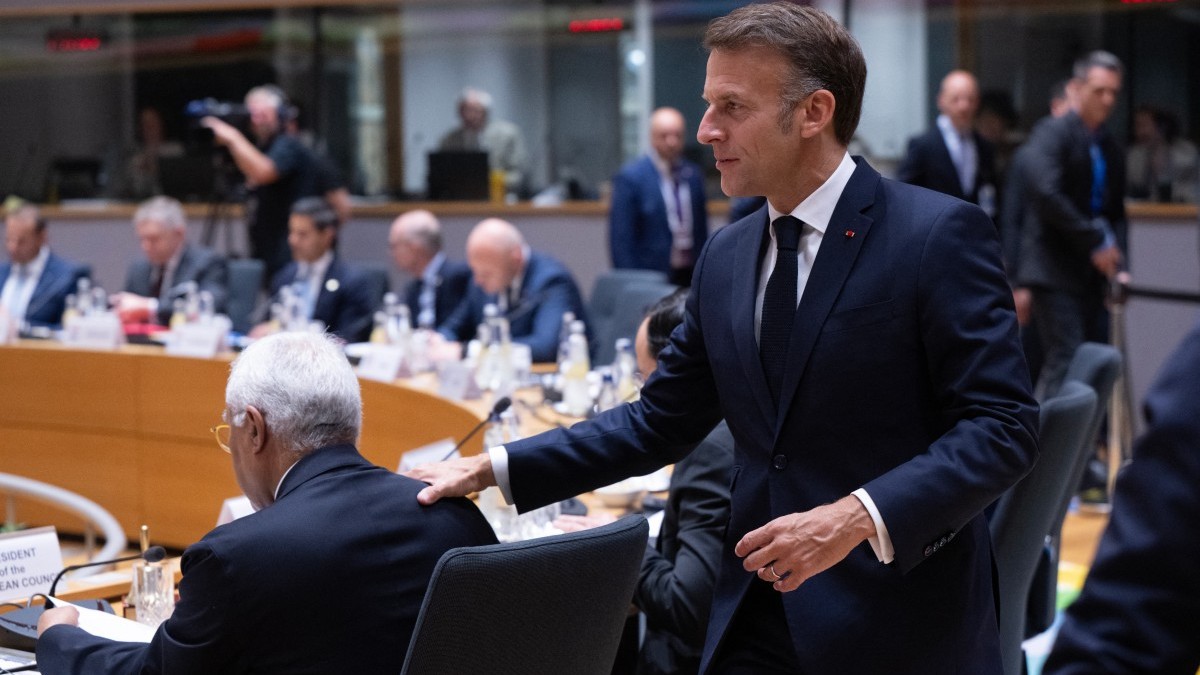
France’s President Emmanuel Macron walks past European Council President António Costa prior to a round table meeting during the EU Summit at the EU headquarters in Brussels, on June 19, 2026.
JOHN THYS / AFP
Thursday marked the beginning of the first European Council summit (EUCO) since former Hungarian PM Viktor Orbán left office, which made many in Brussels believe the meeting would go down without much conflict. The opposite happened.
Behind closed doors, the first night of the two-day summit reportedly descended into a particularly intense playground feud between two opposing camps. The altercation was about who and how should represent the EU in diplomatic talks with Russia over the war in Ukraine, as the bloc is increasingly ready to depart from its four-year strategy of “we don’t talk to terrorists.”
What gave birth to the conflict was the fact that António Costa, the President of the European Council, who represents the 27 national leaders collectively, reached out to Moscow twice in the past few weeks to gauge whether Brussels could take charge of the peace negotiations previously led by Washington.
While most EU countries think this was the right move and were happy that Costa acted on their behalf, the EUCO president angered a smaller but more powerful clique, led by German Chancellor Friedrich Merz and French President Emmanuel Macron.
Mostly backed by the Baltics, Denmark, and the Netherlands, Merz and Macron reprimanded Costa in an unusually harsh way, calling his actions unprofessional and telling him he had no mandate to act as mediator in the war on behalf of the EU. Their primary concern was that Costa’s outreach might have signaled that the EU was ready to consider compromise solutions to end the war, when they aren’t.
“History offers a clear warning about attempts to pursue alternative negotiating frameworks with dictators,” staunchly anti-Russian Estonian PM Kristen Michal said, part of a group of countries that would gladly fight to the last Ukrainian rather than give an inch to Russia.
However, the majority of member states sided with Costa, as they too want some progress in the peace talks as the war drags on in its fifth year. “The first question is whether Putin wants to negotiate. Until then … no one other than Costa can represent the European Union,” Belgian Prime Minister Bart De Wever said. “If he [Putin] shows a willingness to negotiate, then I believe we will have to decide again how we should proceed.”
Of course, the real source of the disagreement is not the moral dilemma between peace and support for Ukraine, but power: who calls the shots in Europe?
Macron and Merz insisted that only the E3—Germany, France, and the UK—are capable of putting appropriate pressure on Russia, and therefore they should lead any and all diplomatic missions as well. This argument likely came across to others as an assertion of the EU being a Franco-German protectorate. Which, unsurprisingly, angered Italy and Poland, the next two biggest countries, who had already been frustrated by their exclusion from E3-Ukraine talks ahead of the summit, and who would rather have things run by an ‘E5’ format.
Leaders of smaller EU countries then apparently suggested that the EU should be represented as a whole, but were again split on the question of by whom exactly. Some say Costa was closer to national governments, others suggested that Commission President von der Leyen had more power, and there were those who said diplomacy should be left to the EU institution specifically created for that, the External Action Service (EEAS). This latter would make the obvious choice, if not for most leaders completely losing trust in the professional competence of EEAS chief Kaja Kallas, who in just two years managed to make the “top diplomat of the EU” position a joke on the international scene.
This fight has already chilled the room enough for few people to expect meaningful progress on the most important item on the agenda tonight, the EU’s next seven-year budget, known as the Multiannual Financial Framework. The 2028-2034 MFF is set to bring a whole new set of major disagreements to the table.
Most of Friday is dedicated to discussing the outgoing Cypriot presidency’s MFF proposal, which mostly kept the Parliament’s €2T mega budget with cohesion and agricultural funds largely intact, and slashing just 2% off the initial figure—even though Cyprus was aware this would not fly with the “frugal” countries.
“The proposal on the table is simply unacceptable on volume,” Swedish PM Ulf Kristersson said. “It’s not a credible starting point—we need significant cuts to be able to move forward. For us, the result is more important than making a deal by the end of 2026.”
The unofficial December deadline is on the minds of many officials in Brussels, who worry that upcoming elections in Sweden, Latvia, Finland, Italy, Spain, and France could complicate things even more than they are now. Patriots leader and French presidential hopeful Jordan Bardella already vowed to slash France’s contributions in half if elected next spring, which would make the current plans effectively impossible to realize.
Still, few leaders want to commit to any deadline: most prefer to stick to what they want to see in the budget for as long as it takes, and this includes both the frugal northern countries not keen on increasing their contributions, as well as the southern member states, which have traditionally been net beneficiaries of cohesion funds that others would rather chop down massively.
“We do not intend to endorse, or bind ourselves to, predetermined and artificial negotiation timelines,” Italian PM Giorgia Meloni said, who’s also up for reelection next year and needs every cent to secure it.
Meanwhile, Chancellor Merz is at the forefront of the push for a solid December deadline, afraid that Bardella’s election might eliminate all chances for a dramatically increased common defense budget.