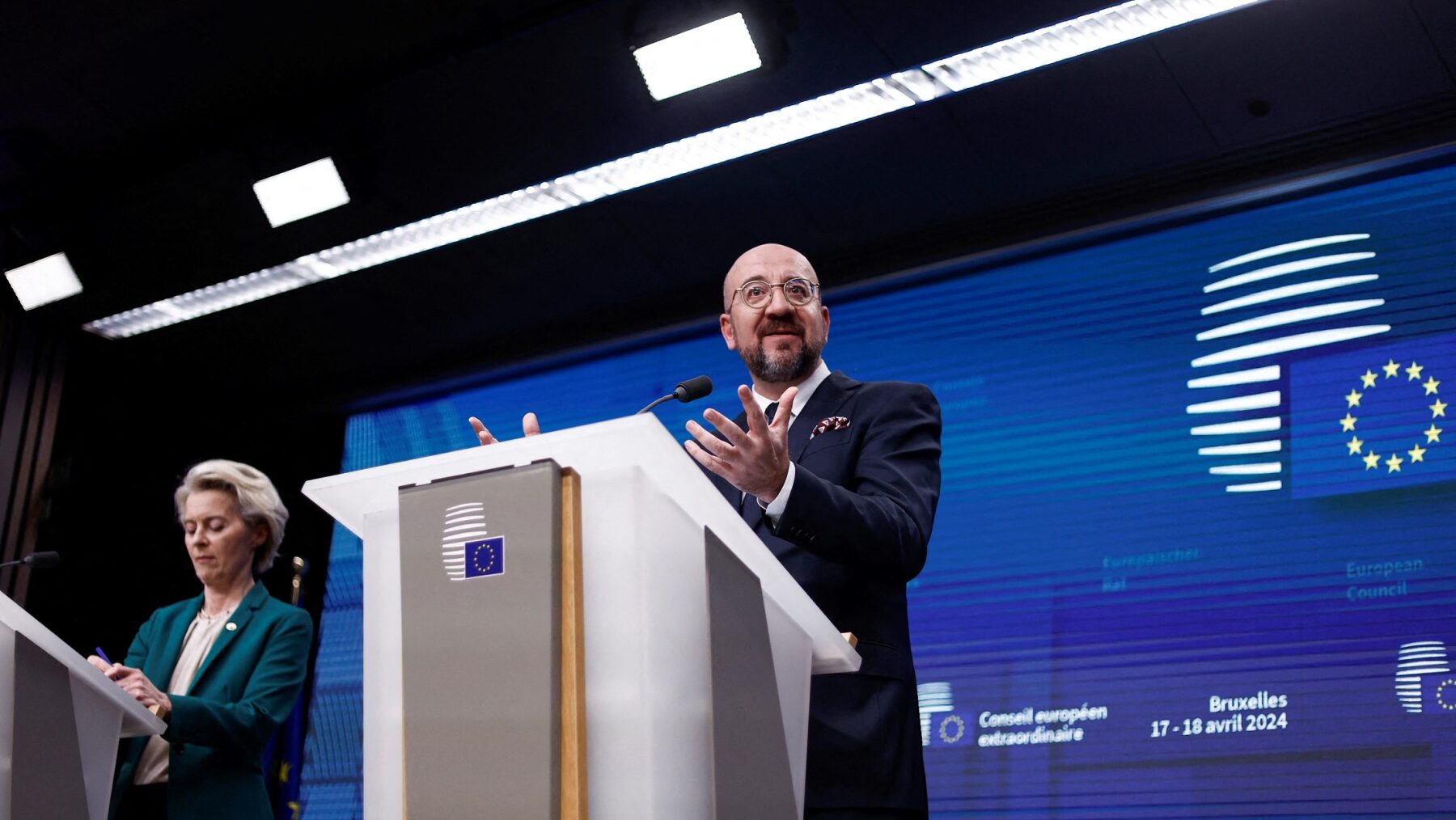
The former president of the European Council, Charles Michel—who spent five years chairing meetings of EU national leaders—has launched a public attack on Ursula von der Leyen, accusing her of centralising power in Brussels and overstepping the bloc’s founding rules.
In an interview with Brussels Times, Michel said the European Commission had used a succession of crises—including the pandemic, the war in Ukraine, and the energy shock—to expand its authority into areas that, under EU treaties, are meant to remain in the hands of member states.
“Today the Commission is trying to take control. That is not in line with the Treaty,” he said.
The criticism goes beyond personal rivalry. Michel argues that von der Leyen has built an increasingly political, centralised, and presidential Commission. “There is a super-authoritarian governance,” he said. “Commissioners no longer have any role.”
He claims the Commission has gradually pushed into areas such as foreign policy, defence, and international representation—where, on paper, the final say belongs to national governments.
That clash was put on public display during the so-called “Sofagate” incident in 2021, when Michel and von der Leyen travelled to Ankara to meet Turkish President Recep Tayyip Erdoğan. The Commission president was left on a side sofa while Michel took one of the two main chairs.
Von der Leyen later suggested she had been sidelined because she was a woman. Michel now says the seating had been agreed in advance and that the Commission used the episode “to try to obtain more institutional power.”
“Everyone knows and has seen how the Commission instrumentalised this incident,” he said.
Behind that moment was a wider disagreement. Michel said he tried to set up regular meetings to coordinate on foreign policy, but that these proposals were “systematically” rejected.
“Never before had I encountered this level of difficulty in working with a colleague,” he said. “It is not a matter of personality. It is a matter of the European project.”
More broadly, Michel argues that the Commission has moved away from its traditional role as a technical body—focused on enforcing EU rules and managing the single market—and has instead taken on a more openly political role.
His criticism echoes long-standing concerns—especially among conservative and sovereignty-minded politicians—that the Commission has stretched its role beyond what the treaties originally set out.
Michel also accuses von der Leyen of neglecting areas that clearly fall within the Commission’s remit. “She is supposed to defend the single market. Nothing has been done. She is supposed to work on financial markets. Nothing has been done. In this field, the result is zero,” he said.
He also criticised how recent crises were handled. During the vaccine negotiations, he said, he pushed back against efforts by the Commission and some governments to act in small groups without involving all 27 member states. Later, he argued, Brussels “wasted months” before responding to the energy shock caused by the war in Ukraine.
Taken together, the interview points to a deeper concern about the direction of the European Union. Michel suggests that the Commission—originally set up to carry out decisions made by member states—is taking on political powers that used to sit with national governments.
The significance of his intervention lies not only in what he is saying, but in who is saying it: not an outsider, but a former holder of one of the EU’s top jobs.
His remarks are likely to fuel an ongoing debate about how power is divided inside the bloc—and whether that balance has already begun to shift.