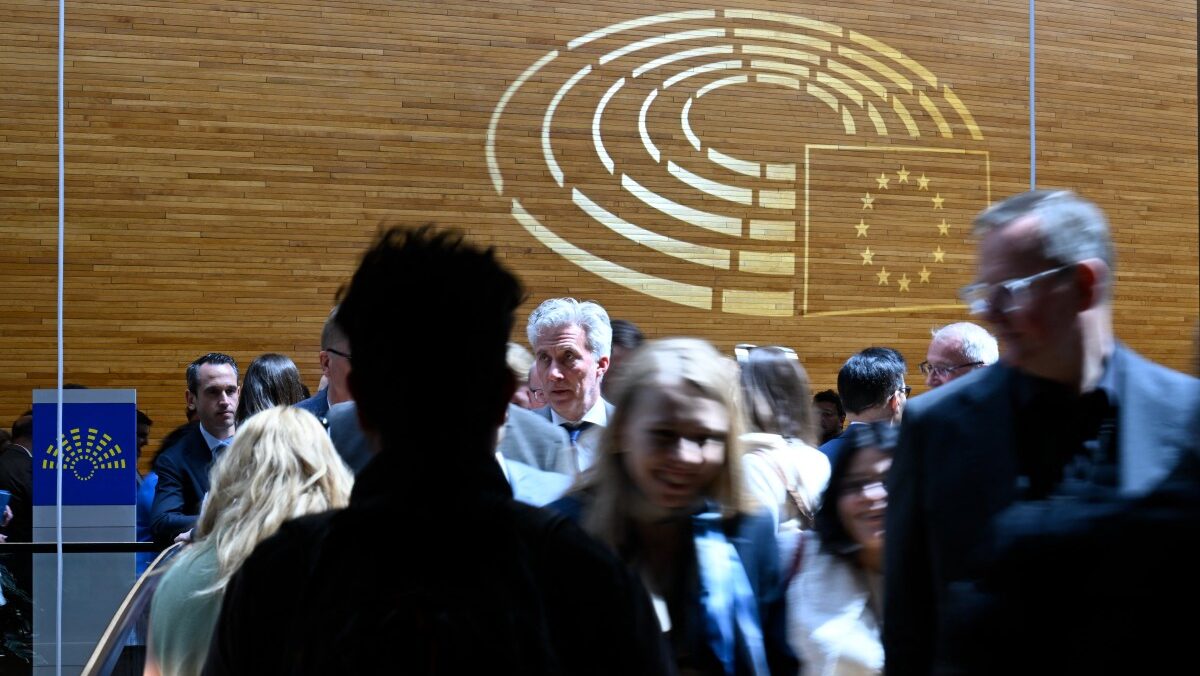
The logo of the European Parliament is photographed as MEPs leave the session in the hemicycle in Strasbourg, France, on April 28, 2026.
JEAN-CHRISTOPHE VERHAEGEN / AFP
The European Parliament on Tuesday drew red lines in the battle over the EU’s next long-term budget, rejecting cuts to agriculture and cohesion even as officials warn of a looming funding gap.
In a resolution adopted in Strasbourg, MEPs made clear that new priorities such as defence and competitiveness should not be funded at the expense of the EU’s main spending programmes.
The stance, setting out Parliament’s position on the EU’s 2028–2034 long-term budget (known as the MFF), reflects a broad cross-party consensus that agriculture, fisheries, and regional development funding should remain untouchable.
But questions grow over how the next budget will be paid for. The European Court of Auditors warned just the day before of a “considerable deficit” without new revenue sources, with member states potentially having to increase their contributions by up to 81%.
📢 Today, the @EUauditors issued an overview of the 12 #opinions on the @europeancommission’s legislative proposals for the period 2028-2034 #EUbudget.
— European Court of Auditors (@EUauditors) April 27, 2026
🔗 Read the overview: 👇 https://t.co/daDLLLlYuB pic.twitter.com/HBNsdxTJjh
In other words, the EU is debating what to spend on without deciding how to pay for it.
“We reject weakening these policies. We want separate budgets for agriculture and cohesion,” the rapporteurs argued, insisting that “there can be no security without food security.”
The same message was repeated across policy areas, with MEPs in agriculture and fisheries committees also rejecting the cuts initially proposed by the Commission as “unacceptable.”
Even among more Eurosceptic groups—including ECR, Patriots, and ESN—there was broad agreement. Hungarian MEP Kinga Gál warned that cutting support for regions and farmers while expanding other spending “will end up backfiring on the Union itself.”
Taken together, the debate shows a broad push to keep EU spending focused on local economies, farming, and regional development rather than shifting funds toward new priorities.
On the one hand, the volume of around €1.4 trillion that would go to the United States under the agreement reached between Brussels and Washington and, on the other, the roughly €800 billion linked to the new ambition in European defence.
The sum places the budgetary horizon well above €2 trillion. And yet, the debate has focused on internal allocation rather than overall magnitude. Discussing priorities without integrating the real volume amounts to fragmenting the problem.
Some MEPs pointed this out indirectly: “The question is how we are going to pay for this,” more than one rapporteur asked. Some even suggested lowering taxes to boost consumption and thus increase VAT revenues. This is not the first time such an idea has been proposed: more money in taxpayers’ pockets to drive consumption, but it does not seem to resonate with the Union’s financial decision-makers.
This connects directly with the Court of Auditors’ warning: without new ‘own resources’—European taxes—the system does not add up.
The Commission proposes to expand these ‘own resources’—levies on large companies, emissions, or digital activity to finance the budget without formally increasing national contributions. In other words, more taxes—the opposite of what others propose.
The debate in Strasbourg shows that this move carries deep political implications. Sovereigntist groups interpret it as a step towards giving the EU more power to raise and control its own money and, with it, greater centralisation.
At the same time, the new budgetary architecture—with national plans and greater flexibility—strengthens Brussels’ ability to condition access to funds. The link between financing and political compliance is consolidated.
Among the major groups, the direction is shared: the budget must grow.
The centrist EPP insists on strengthening defence, competitiveness, and support for Ukraine, without cutting cohesion or agriculture. The Social Democrats prioritise social spending and the protection of the European model. The difference lies in the destination of the money, not in its volume.
The debate leaves a difficult image to erase. On one side, a majority is trying to preserve the policies that sustain the legitimacy of the European project on the ground. On the other hand, growing pressure to finance new geopolitical ambitions increases the cost of the system.
Commissioner for Budget, Anti-Fraud and Public Administration Piotr Serafin summed it up bluntly: “We cannot afford everything.”