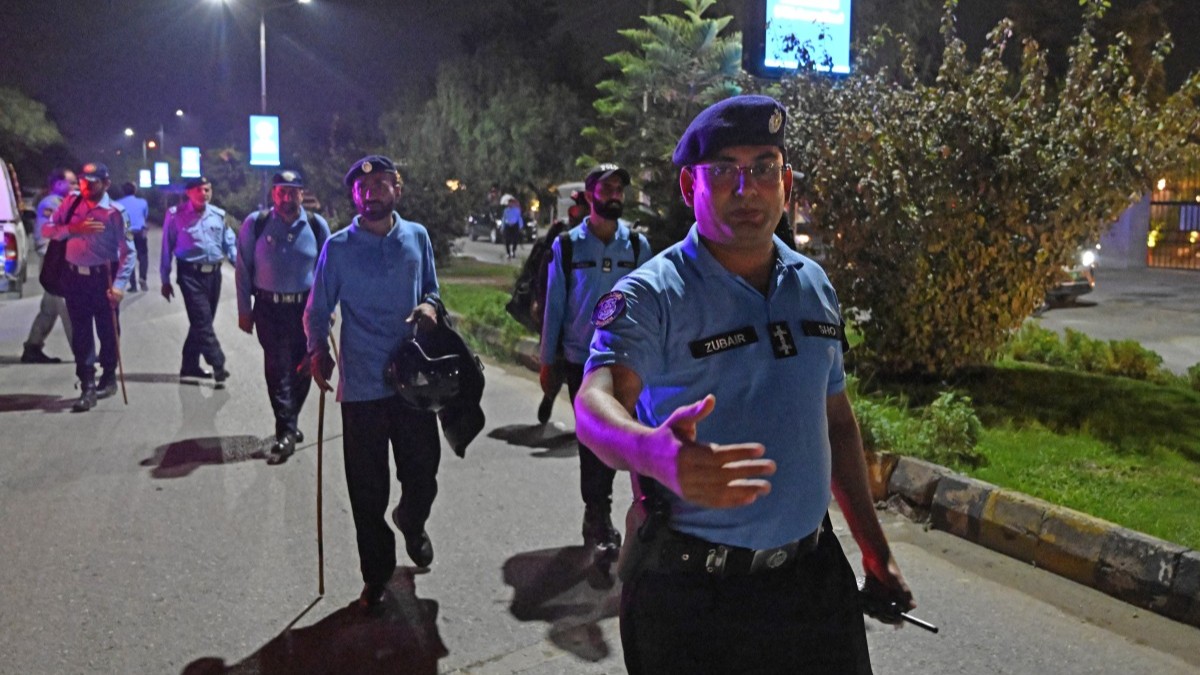
Security personnel clear the road as they cordon off a street outside the Shifa International Hospital in Islamabad on August 20, 2026, after Pakistan’s Supreme Court ordered to transfer jailed former prime minister Imran Khan to hospital for medical treatment.
AAMIR QURESHI / AFP
The European Union wants to deepen its economic relationship with Pakistan. Still, Islamabad has a problem that is difficult to separate from trade with Brussels: its human rights record.
The latest focus is on Pakistan-administered Kashmir —PoJK—, where a wave of protests that began at the start of the summer has ended with dozens of civilians killed, a prolonged communications blackout, and the growing use of the anti-terrorism apparatus against local organisations and activists.
All of this directly affects the conditions Pakistan must meet to preserve its privileged access to the European market.
Pakistani security forces have caused around 90 deaths since early June. Amnesty International had documented at least 40 deaths by July 28, while local sources put the toll above 70.
The crackdown has not been limited to the streets. Since June 5, parts of the region have faced restrictions on telephone and internet services. The same decision extends to control over information.
An operation by the national cybercrime agency also opened the door to blocking YouTube channels linked to journalists and opposition figures.
This long list is now firmly in Brussels’ sights.
Pakistan has benefited from the GSP+ system since 2014, granting preferential or zero tariffs on roughly two-thirds of EU tariff lines. More than 85% of its exports to Europe currently enter duty- and quota-free under the scheme, while the Union accounted for around 28% of all Pakistani exports in 2024. Textiles and clothing represent between 70% and 76% of its sales to the European market.
But those advantages come with conditions. The EU requires the effective implementation of international conventions covering civil rights, freedom of expression and association, judicial guarantees, the prohibition of torture, labour rights, and protection against forced and child labour. Signing the treaties is not enough; Pakistan must also demonstrate a proactive approach in these areas.
The problem for Islamabad is that the dossier does not end with Kashmir.
European monitoring has also highlighted the detention of former prime minister Imran Khan, the trials of civilians before military courts, and restrictions on the political opposition.
Meanwhile, the economic relationship continues to grow. The latest EU-Pakistan Strategic Dialogue opened new avenues for cooperation in investment, energy, digital infrastructure, climate, migration and mobility. More than 300 European companies are already participating in the new bilateral business network.
What happened this summer could lead to a shift in the European position once Brussels returns from the summer recess.