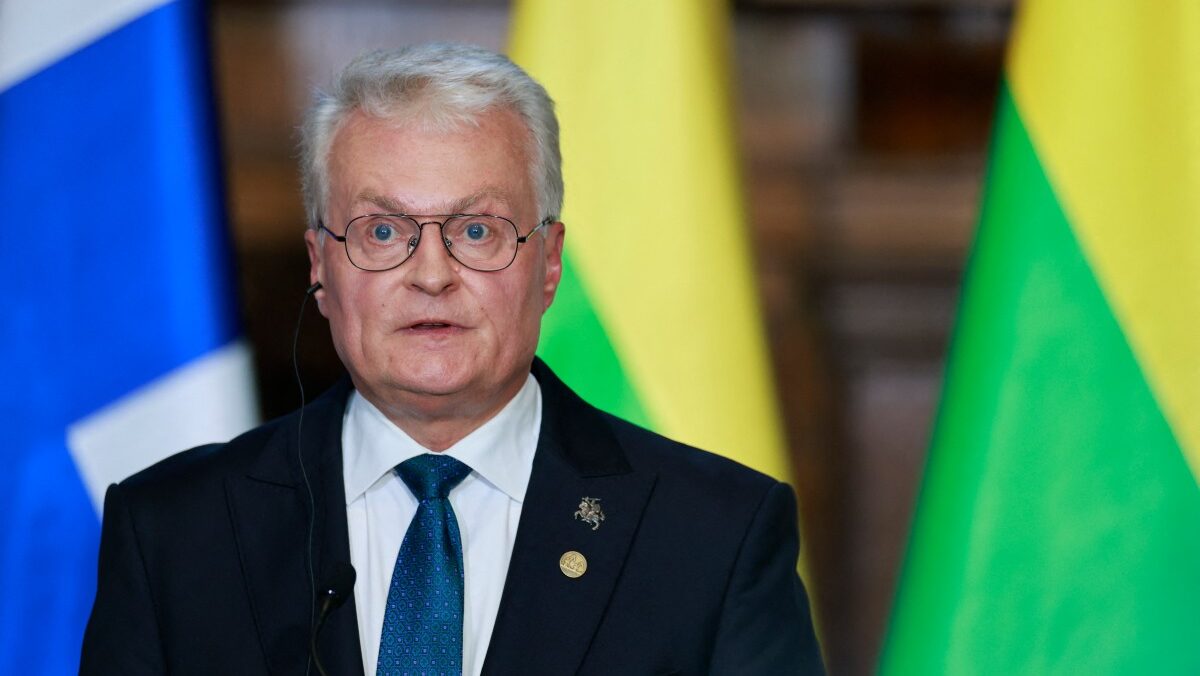
Lithuanian president Gitanas Nausėda has said the country’s constitutional ban on nuclear weapons and foreign military bases has become “outdated,” as neighbouring Finland formally ended its own nuclear restrictions this week.
Nausėda said Lithuania’s main political parties had agreed in principle that the constitutional prohibition on the deployment of nuclear weapons should be removed. He argued that Article 137 of the Lithuanian Constitution, which bans weapons of mass destruction and foreign military bases on Lithuanian territory, no longer reflects today’s security environment.
“The geopolitical situation is getting worse. Our constitution was written when geopolitical circumstances were totally different,” Nausėda said, describing the provision as “outdated” and “obsolete.”
Lithuania, which borders both the Russian exclave of Kaliningrad and Moscow’s ally Belarus, already hosts a NATO multinational battlegroup, including a permanent deployment of up to 5,000 German troops. While no plans have been announced to station nuclear weapons there, removing the constitutional ban would make such a deployment legally possible in the future.
The move follows a similar policy change in Finland. On June 17, the Finnish parliament voted 125-61 to repeal the country’s longstanding legal ban on nuclear weapons, bringing Finnish law into line with its NATO commitments after the country joined the alliance in 2023.
The legislation repealed Finland’s ban on the import, production, possession, and detonation of nuclear explosives by amending both the Nuclear Energy Act and the criminal code. The law, which took effect on July 1st, allows nuclear weapons to be brought into, transported through, supplied, or possessed in Finland whenever required for the country’s defence. Earlier in June, Prime Minister Petteri Orpo also expressed interest in joining a French-led nuclear deterrence arrangement.
Finland has also announced plans to partner with U.S. defence company Lockheed Martin to build Europe’s first maintenance centre for multiple-launch rocket systems (MLRS) in Tampere.
Moscow reacted angrily to Finland’s policy change and has also criticised Lithuania’s plans. Aleksey Zhuravlyov, first deputy chairman of the Russian State Duma Defence Committee, accused Finland of becoming “a second Ukraine” and claimed Russia had the military capability to destroy half the country.
For the Kremlin, the prospect of allied nuclear weapons being stationed in either Finland or Lithuania would bring NATO’s nuclear deterrent significantly closer to strategic Russian territory, including Kaliningrad and Belarus. Although neither Helsinki nor Vilnius has announced plans to host nuclear weapons, both countries are moving to remove the legal barriers that would prevent such deployments.