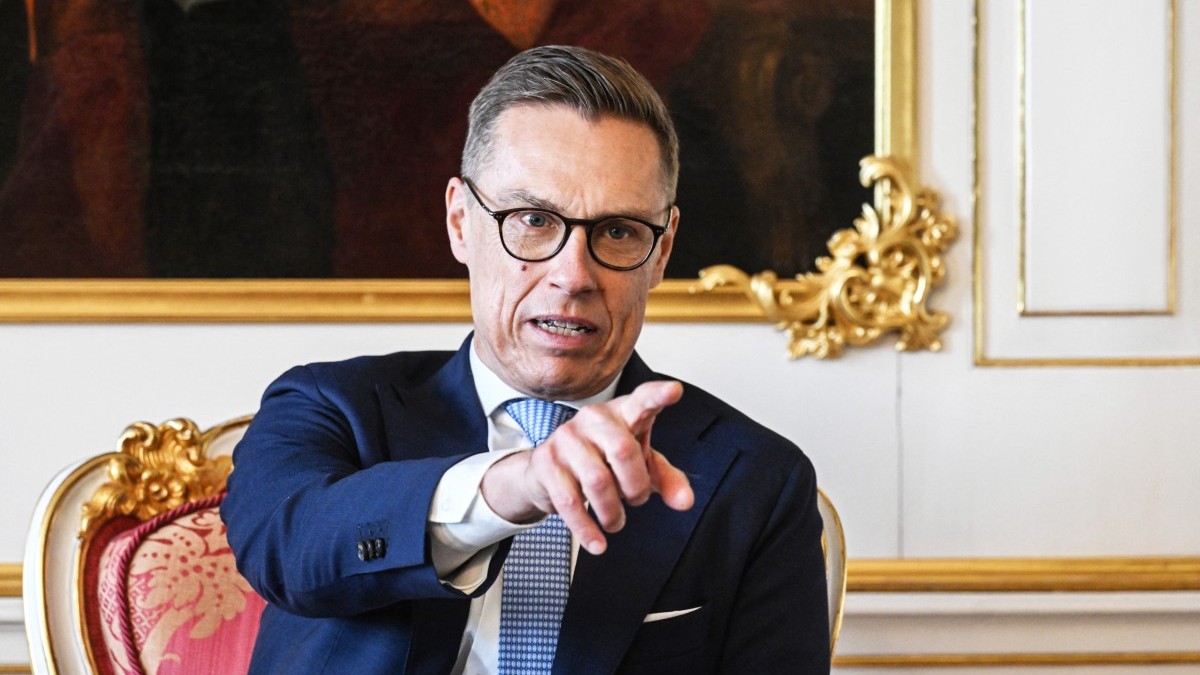
Finland’s President Alexander Stubb at the Prague Castle in the Czech Republic, on May 4, 2026
MICHAL CIZEK / AFP
Statements by Finnish President Alexander Stubb in an interview published by Czech outlet Respekt reflect the strategic shift currently reshaping NATO and the European Union.
The Finnish leader rejects the idea that the Atlantic Alliance is in crisis but acknowledges that the internal balance is rapidly changing: the United States will remain present, although increasingly less willing to carry the main burden of European security.
“The burden-sharing of security is shifting from America to Europe,” Stubb summarises. And he adds something significant coming from Finland: “I think that’s a good thing.”
The Trump administration has confirmed the partial withdrawal of U.S. troops from Germany as Washington concentrates resources on the Indo-Pacific and the Middle East. At the same time, Russia is continuing the war in Ukraine, intensifying hybrid operations against European countries, according to Brussels, a situation that is leading NATO members to accelerate rearmament programmes that had been politically blocked for years.
NATO has adopted spending targets close to 5% of GDP for the next decade, levels not seen since the Cold War. Brussels, for its part, is promoting mechanisms such as SAFE, the fund of up to €150 billion aimed at financing European military capabilities, while countries such as Poland, Finland, and the Baltic states lead the increase in defence investment.
Stubb speaks from a particularly sensitive position. Finland shares 1,340 kilometres of border with Russia, and its entry into NATO doubled the Alliance’s direct border with Russian territory. In just three years, Helsinki has gone from historic neutrality to becoming one of the military pillars of Europe’s northern flank, a move highly welcomed by the Alliance and especially by Washington.
However, in the interview, the Finnish leader tries to tone down some of the alarmism dominating certain European capitals more inclined toward military escalation. He considers it unlikely that Moscow would directly test NATO’s Article 5. His argument is military rather than political: Russia is accumulating enormous human losses in Ukraine and advancing slowly despite more than four years of war. “I do not believe they have either the capability or the willingness to confront the strongest military alliance in history,” he argues.
That does not imply a reduction of the threat. Finland, Estonia, and Poland have spent months warning about a constant increase in sabotage, cyberattacks, GPS interference, hybrid attacks, and organised migratory pressure along Europe’s eastern borders.
The problem is no longer only a conventional invasion but a permanent war of attrition targeting infrastructure, energy, information, and internal stability. This hybrid war did not exist when Russia and Europe were commercial partners. At least not at current levels.
Another important shift also emerges here: Ukraine is no longer seen only as a country receiving assistance and is beginning to become a military asset for Europe. Ukrainian experience in drones, electronic warfare, and high-intensity combat is directly influencing NATO doctrines and industrial programmes.
Stubb implicitly admits this when he argues that Europe must build its own defence capability compatible with a more European NATO. That European NATO can be understood as the embryo of a European army long desired by Brussels but which, given American belligerence, cannot currently be understood outside an Alliance that Washington claims to disdain but needs more than ever.