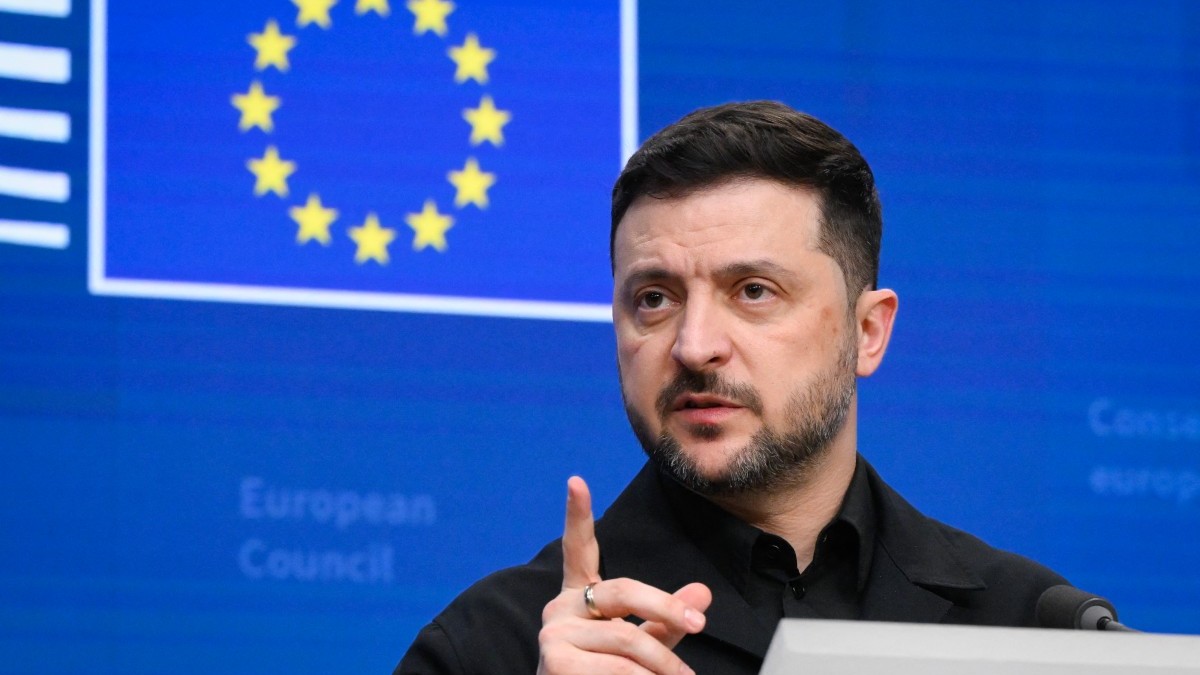
Ukraine’s President Volodymyr Zelensky speaks during a press conference as part of the European Council meeting in Brussels on December 18, 2025.
JOHN THYS / AFP
Ukraine’s bid to begin formal European Union accession negotiations appears closer than at any point in recent years after Hungary signalled it may soon lift its veto. However, a growing diplomatic dispute between Kyiv and Warsaw has raised the prospect that Poland could emerge as a new obstacle on Ukraine’s path towards membership.
Hungarian Prime Minister Péter Magyar said on Tuesday, June 2nd, that he was “very optimistic” about resolving a decade-long dispute over the rights of the Hungarian minority in western Ukraine, suggesting that a technical agreement could be reached within days.
Magyar said he would be prepared to meet Ukrainian President Volodymyr Zelensky early next week if an agreement is reached on what he described as the “fundamental human rights” of ethnic Hungarians living in Ukraine.
The dispute centres on a series of Ukrainian laws introduced since 2015 that have restricted the use of minority languages in education, administration, and cultural life. Under former prime minister Viktor Orbán, Hungary repeatedly blocked progress in Ukraine’s path toward the EU and NATO, insisting that Kyiv restore the rights of the Hungarian community in Transcarpathia.
Diplomatic sources in Brussels now indicate that Hungary is prepared to lift its objections after receiving assurances from Ukrainian officials on addressing most of Budapest’s concerns.
What those assurances are remains unclear for now.
If an agreement is reached, EU member states could approve the opening of the first accession cluster of negotiations for both Ukraine and Moldova as early as mid-June.
The move would represent a major breakthrough for Kyiv. Accession negotiations are divided into six clusters and require unanimous approval from all 27 member states at every stage.
The first cluster focuses on democratic institutions, the economy, and the rule of law—chapters linked to the treatment of minorities in Ukraine.
Yet even as one obstacle appears to be fading, another has emerged.
Relations between Ukraine and Poland have deteriorated sharply after Zelensky renamed a Ukrainian military unit in honour of the ‘Heroes of the UPA,’ referring to the Ukrainian Insurgent Army.
While many Ukrainians view the UPA as a symbol of resistance against Soviet domination, the organisation is associated in Poland with the Volhynia massacres, during which more than 100,000 Polish civilians were killed during the Second World War.
The decision sparked outrage across the Polish political spectrum.
Polish President Karol Nawrocki has begun efforts to strip Zelensky of Poland’s highest state honour, while politicians from both government and opposition parties have condemned what they regard as the glorification of perpetrators of genocide.
Ukraine’s Foreign Minister Andrii Sybiha has called for dialogue and insisted there was “absolutely no anti-Polish intent” behind the decision. Nevertheless, Ukrainian commentators have warned that the dispute could complicate Kyiv’s European ambitions if Warsaw adopts a harder line.
Ukrainian political analyst Volodymyr Fesenko told Ukrainian outlet RBC that the immediate danger remains limited because Prime Minister Donald Tusk leads a broadly pro-European government that favours maintaining constructive relations with Ukraine and seeking compromise.
However, if Polish policy were to move closer to the more confrontational approach advocated by President Karol Nawrocki and some conservative forces, Ukraine could face serious problems in its relations with Warsaw.