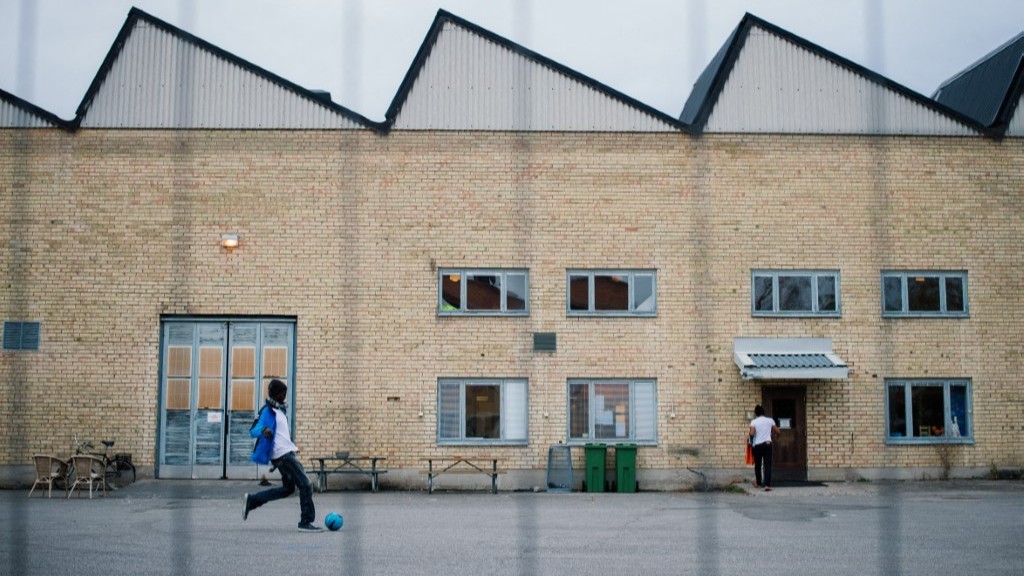
Refugees play football outside their shelter in Sundbyberg, north-west of Stockholm on October 13, 2015.
JONATHAN NACKSTRAND / AFP
Sweden’s parliament has approved a new law allowing authorities to revoke residence permits from ‘badly behaved’ migrants.
The legislation, passed by the Riksdag on Monday, June 15th, enables the Swedish Migration Agency to withdraw both pending and already granted residence permits if a foreigner is deemed to have engaged in misconduct. The new rules will enter into force on July 13th.
Under the law, authorities will be able to deny or revoke residence permits for failing to comply with laws or official decisions, accumulating significant unpaid debts, evading taxes, working illegally, or being linked to extremist or criminal organisations.
Migration Minister Johan Forssell has defended the measure, arguing that residence in Sweden should come with responsibilities. “Anyone who doesn’t make the effort to do the right thing shouldn’t be able to count on staying,” he said when presenting the proposal earlier this year.
The reform forms part of a broader tightening of Sweden’s migration policy by the centre-right coalition government, which relies on parliamentary support from the right-wing Sweden Democrats. The party celebrated the vote, saying it was delivering on election promises to introduce “character requirements” for residence permits.
Critics have condemned the legislation as vague and legally uncertain because it allows decisions to be based on behaviour that is not necessarily criminal. The Stockholm-based organisation Civil Rights Defenders warned that the measure “undermines the rule of law” by leaving migrants uncertain about which actions or expressions could be used against them.
The ‘good behaviour’ law is only the latest in a series of restrictive immigration reforms.
Swedish lawmakers recently voted to abolish the possibility of permanent residence permits for many asylum seekers, while the government has also adopted tougher citizenship requirements, requiring applicants to speak Swedish, understand how Sweden works, earn a monthly minimum of SEK 20,000 (€1,880), and be a resident of Sweden for at least eight years.
The tougher stance reflects growing public concern over gang violence and integration failures.
Immigration and crime are expected to dominate the campaign before September’s parliamentary election. The opposition Social Democrats, who currently lead in opinion polls, could roll back the policies of the past four years.