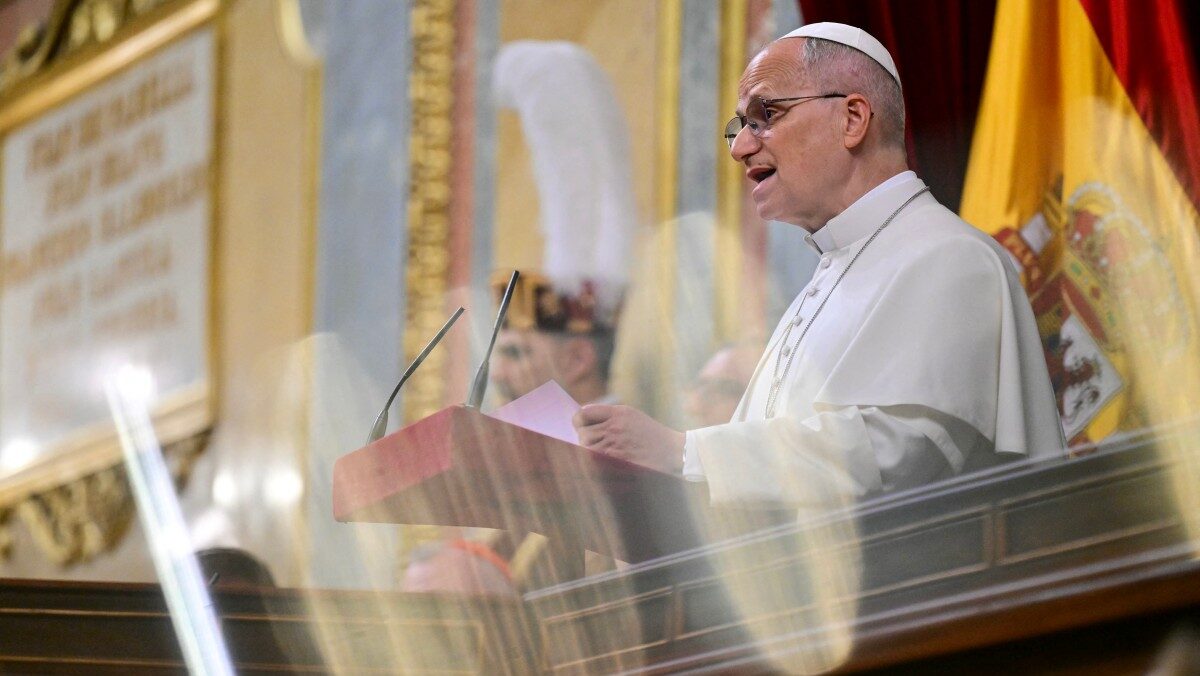
Pope Leo XIV’s address to the Spanish Parliament on Monday offered a reminder of something that parts of the public debate often forget: a pope is still a pope.
What they heard was a Catholic speech.
Not a partisan speech. Not an electoral intervention. Nor a call to amend specific laws. Leo XIV did what one would expect from the head of the Catholic Church: he presented the Christian vision of the human person, society, and politics.
The pope began by reaffirming Spain’s history as a nation shaped by a unique cultural and spiritual heritage. He recalled that Spanish identity has been built upon a tradition in which “faith and reason, art and law, tradition and thought have fruitfully encountered one another,” and noted that this heritage remains alive in the country’s institutions, culture, and national consciousness.
He also devoted a significant portion of his address to the School of Salamanca, Francisco de Vitoria, and the Spanish intellectual tradition that helped shape modern international law. Far from presenting national history as a succession of collective sins, Leo XIV spoke of a Spain capable of combining historical action with moral reflection.
But it was the second half of the speech that triggered the strongest reactions.
The Pontiff stated that human dignity precedes the State and does not depend on “changing social consensuses or the shifting majorities of any given moment.”
He then addressed directly some of the most sensitive issues related to what Christians have traditionally called the culture of death.
He asked whether a society can be considered fully just when it leaves “in the shadows the unborn child, the elderly, the sick, or those who depend entirely on the care of others.” He argued that “every human life must be recognized and protected from conception until its natural end” and defined the protection of life as “a goal of civilization.”
He also reaffirmed the central role of the family as the “natural foundation of the community,” arguing that it is within the family that collective memory is transmitted and social coexistence is learned.
At the same time, he defended the right of parents to choose the education of their children in accordance with their moral, cultural, and religious convictions.
The same speech also included a broad defense of the dignity of migrants, the need for legal immigration routes, integration, and the right of people not to be forced to leave their countries of origin.
During the first days of his trip to Spain, much of the political and media Left enthusiastically embraced the Pontiff’s references to migrants, solidarity, and caring for the most vulnerable. His words were quickly used to attack the right and to portray the new pope as a figure aligned with certain progressive causes.
That narrative, however, began to unravel after the speech Leo XIV delivered before deputies and senators gathered in the Spanish Parliament at the invitation of the parliamentary majority.
Social media quickly filled with messages claiming that the pope had come to Parliament in an attempt to drag Spain “back to the Middle Ages” or to impose religious principles on public life. These criticisms stood in stark contrast to the praise that the same sectors had offered only days earlier for his remarks on immigration and solidarity.
That difference in treatment is revealing. Leo XIV did not change his message. He defended the vulnerable at the borders and also defended the vulnerable before birth. He called for the integration of those who arrive and for the protection of those approaching the end of life.
The Church does not operate through isolated quotations. It functions as a complete body of doctrine. And when a Pope decides to present it in its entirety, those who applauded one page often discover, not without irritation, the other five hundred.
Leo XIV said nothing extraordinary for a Pontiff. What is extraordinary is how many people seemed to expect that he would not say it.