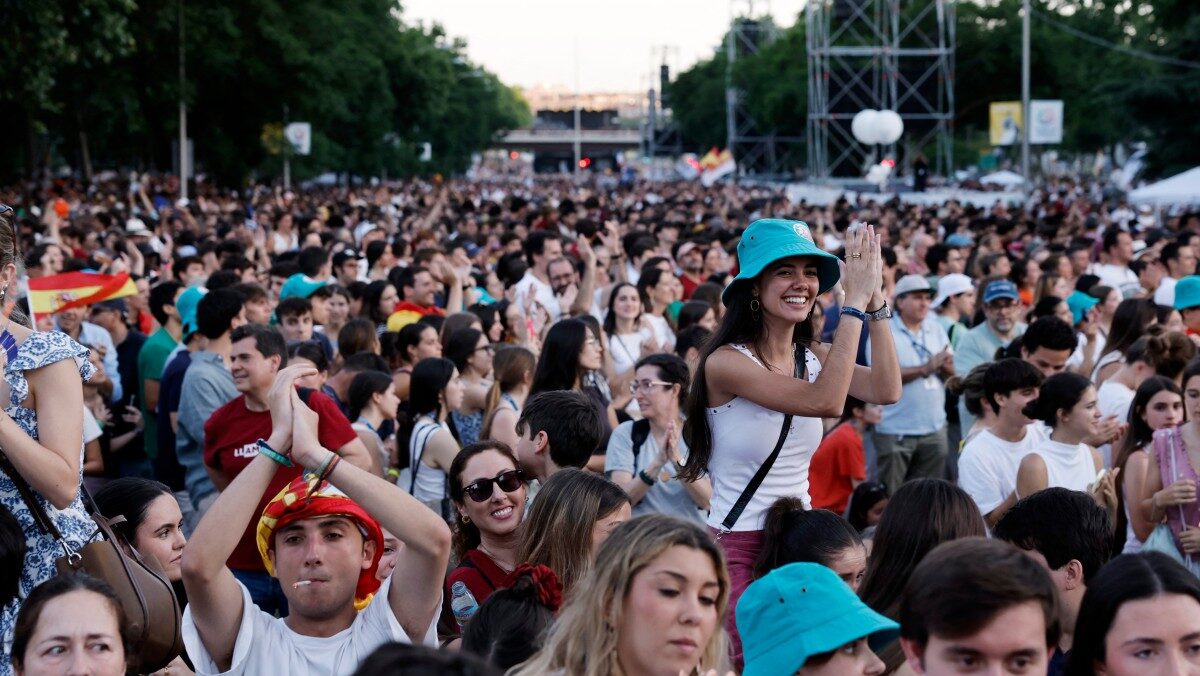
Young people attend a prayer vigil with Pope Leo XIV in the Plaza de Lima in Madrid on June 6, 2026.
Oscar DEL POZO / AFP
While much of the European media’s attention remains focused on security concerns, immigration, and social tensions in major cities, Spain presented a very different image this weekend.
Hundreds of thousands took part in processions, liturgical ceremonies, and other Catholic celebrations linked to the Pope’s apostolic visit and festivities held across the country. The events unfolded in complete normality. There were no major disturbances, clashes with police, looting, arson attacks, or episodes of urban violence.
The contrast was particularly striking given the broader European backdrop.
Just a few days ago, celebrations following Paris Saint-Germain’s victory in the UEFA Champions League final descended into serious riots in Paris and other French cities. Dozens of vehicles were set on fire, numerous businesses suffered damage, and security forces carried out hundreds of arrests. Similar scenes unfolded in various neighbourhoods where police struggled to contain the disorder.
The contrast did not go unnoticed on social media.
Cuando vas a ver al Papa /// cuando celebras un título del PSG
— ᴍᴀɴᴜ. (@ESnomanu) June 7, 2026
Me salen unas cuantas diferencias. pic.twitter.com/4vmGAJxvuL
On one side were public squares filled with families, children, and pilgrims taking part in large-scale religious celebrations. On the other were images of barricades, smashed shop windows, and clashes with police during sporting celebrations.
The comparison is imperfect. The events were different in both purpose and character. But the visual contrast between the two scenes is difficult to ignore.
For decades, much of Europe’s political elite has argued that national identity, cultural traditions, and religious heritage play an increasingly marginal role in modern and diverse societies. Yet the events of this weekend once again raise an uncomfortable question: what binds a society together, and what pulls it apart?
Spain remains one of the European countries with a strong Christian cultural heritage, even in the context of growing secularisation. Large religious celebrations continue to mobilise hundreds of thousands of people peacefully year after year. This is not simply a matter of faith. Cultural traditions, family structures, and a shared sense of identity also help shape common social norms.
This is the view of 1.2 million people from above. This is happening in Madrid, in the famous Plaza de Cibeles and its surroundings, where Pope Leo XIV will preside over the solemn Corpus Christi Mass, followed by a historic procession. pic.twitter.com/KYLIK6ek1V
— EWTN Vatican (@EWTNVatican) June 7, 2026
Meanwhile, several European countries are facing growing difficulties integrating parts of the populations that arrived during the major migration waves of recent decades. France is perhaps the clearest example. Periodic tensions in certain suburbs, security problems, and recurring riots have fuelled an intense political debate for years about the limits of the multicultural model.
Official reports and academic studies have repeatedly linked urban unrest in countries such as France, Sweden, and Germany to neighbourhoods marked by failed integration, entrenched social exclusion, and high levels of crime. In fact, several European governments now openly acknowledge that some migration policies pursued over recent decades have generated cohesion challenges that remain unresolved.
That is why the images from Spain carried a significance that extended well beyond religion.
They do not merely reflect a large-scale Catholic celebration. They also reflect a society capable of gathering hundreds of thousands of people in public spaces without the day descending into disorder.
In a Europe where security has become a growing concern for millions of citizens, that difference is beginning to attract more attention than many leaders in Brussels would like. Because beyond speeches and statistics, images often possess a political power that is difficult to refute. And this weekend’s images appeared to capture two increasingly divergent European realities.