Keir Starmer
HENRY NICHOLLS / AFP
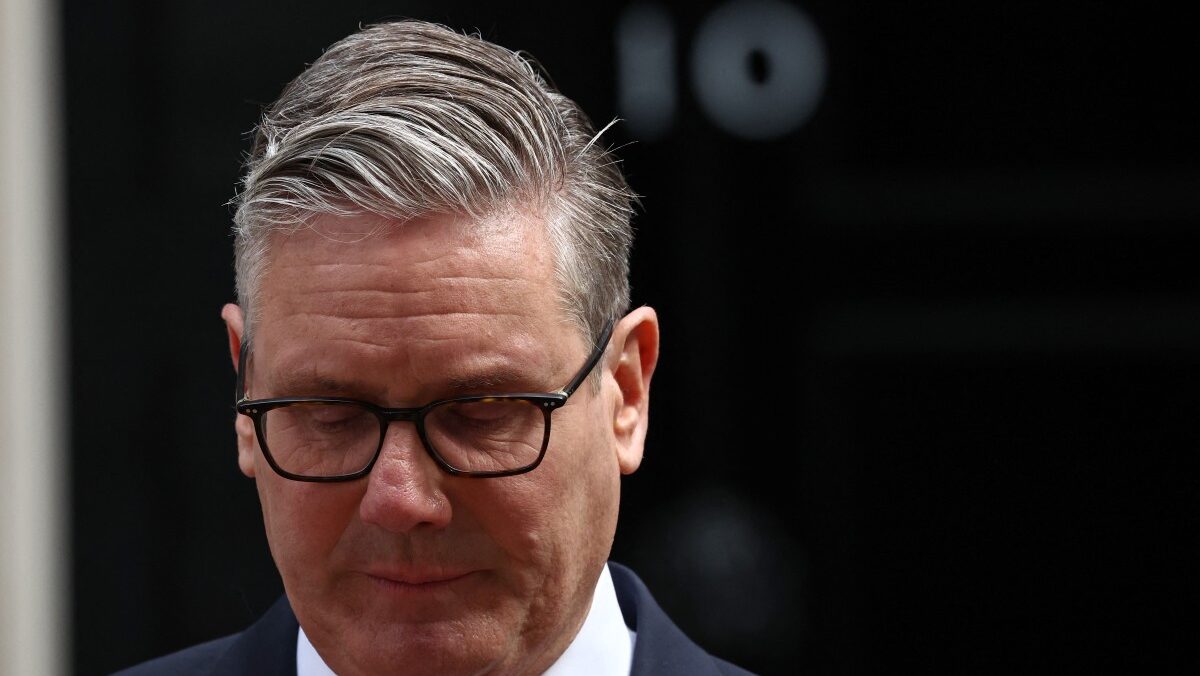
Britain appears to be enjoying a rare moment of political unity following Keir Starmer’s resignation. Within minutes of the prime minister’s departure announcement, social media was flooded with memes, jokes, and celebratory posts from across the political Right.
One widely shared joke video claimed to show crowds in a sports bar cheering Starmer’s resignation speech, while another purported to show jubilant football fans celebrating the news.
Live reaction to Keir Starmer resigning 😆👏🏻 pic.twitter.com/2GDpHOvzFP
— Hazel Appleyard (@HazelAppleyard) June 22, 2026
🚨🇬🇧 WATCH: Brits ERUPT as Starmer announces his RESIGNATION.
— Global Dissident (@GlobalDiss) June 22, 2026
Cheering, jumping and celebrating like they won the lottery.
They couldn’t wait to see the back of him! pic.twitter.com/HSjDfZfQkJ
Other viral posts featured AI-generated parodies of Starmer’s farewell address and jokes about the former prime minister moving out of 10 Downing Street.
David Attenborough narrates as Keir Starmer delivers his resignation speech.
— Aɴᴛ (@AntSpeaks) June 22, 2026
An important documentary.
Disclaimer: This is not the real David Attenborough, nor is it associated with him or representative of his views in any way. The narration uses an AI-generated voice for… pic.twitter.com/ZO0Vs0KUBq
Literally the whole of the UK when Keir Starmer started crying pic.twitter.com/vnFcXE5CiW
— BRITAIN IS BROKEN 🇬🇧 (@BROKENBRITAIN0) June 22, 2026
Even the Royal Mail’s official X account joined in.
Moving home?
— Royal Mail (@RoyalMail) June 22, 2026
Remember to redirect your mail ✉️ https://t.co/DgDFRfZ1Hk pic.twitter.com/S3mfvvKKyA
The outgoing Labour leader leaves office after a period marked by failure to tackle illegal migrant crossings of the English Channel, repeated policy U-turns, tax rises, the Mandelson scandal, and a growing sense among voters that his government had failed to deliver the “change” promised in 2024.
Yet those on the political Right, Starmer’s departure is not necessarily a cause for optimism.
His likely successor, Andy Burnham, is widely viewed as being further to the Left than the man he is replacing. Critics warn that Labour MPs have convinced themselves that changing the face at the top will solve the party’s deeper problems without addressing the policies that made Starmer unpopular in the first place.
Burnham is expected to become Britain’s seventh prime minister in ten years, a level of political instability that commentators note now exceeds even that of Italy, once regarded as Europe’s byword for revolving-door governments.
Several commentators have also warned that Burnham could enter Downing Street without facing meaningful scrutiny. Former Labour minister Tom Harris compared the situation to Gordon Brown’s succession in 2007, arguing that a coronation rather than a contested leadership race risks leaving voters uncertain about what Burnham actually believes and undermining his legitimacy from the outset.
Eurosceptics have raised another concern. Former Brexit secretary David Davis warned that Labour would “cease to exist” if it attempted to rejoin the European Union, a warning aimed squarely at Burnham, who has previously expressed support for Britain eventually returning to the bloc. Davis argued that millions of working-class and former Labour voters would see any attempt to reverse Brexit as proof that the political establishment still refuses to listen to them.
Others fear Burnham’s answer to Britain’s problems will simply be more state spending, higher taxes, and greater government intervention. Critics point to his record as mayor of Greater Manchester and his long-standing enthusiasm for regional subsidies and public-sector expansion as evidence that a Burnham government could move Labour further left rather than towards the political centre.
For now, much of Britain is celebrating Starmer’s departure. The bigger question is whether the man waiting to replace him will prove any more capable of reversing the country’s political, economic, and cultural decline—or whether Labour has simply exchanged one failing prime minister for another.