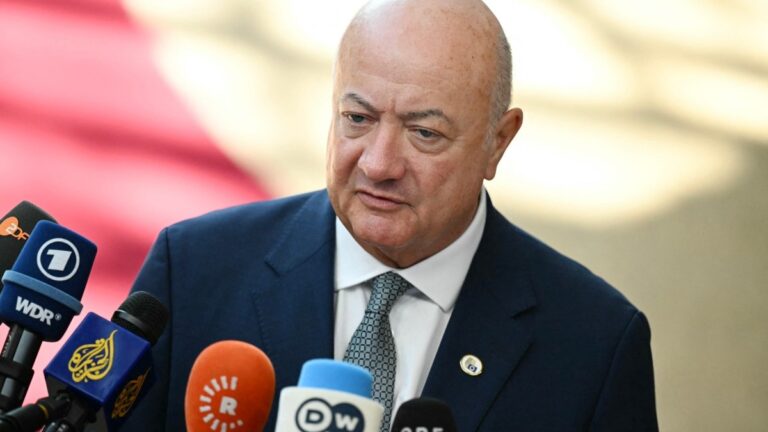
Jean-Luc Mélenchon is gaining ground as France’s 2027 presidential race takes shape, exploiting a divided Left and sluggish centrist campaigns. Still deeply unpopular, the chameleon-like Insoumis leader may yet prove far more dangerous than his current ceiling suggests.

Dave Garcia on Pexels
A group of states at the United Nations has launched a political declaration calling for an international moratorium on surrogacy, marking a significant first step in what its supporters hope will become a global abolitionist framework.
The declaration, spearheaded by Italy and Chile, was presented on June 22 on the sidelines of the 62nd session of the UN Human Rights Council. It was co-hosted by Italy, Chile, Cameroon, and the Holy See, with ADF International moderating the event.
The document is not binding. No state is legally compelled to change its domestic law because of it. But in diplomatic terms, the move really matters: it places surrogacy on the international human rights agenda not as a private contractual arrangement but as a transnational practice raising questions of exploitation, commodification, parentage, nationality, and the rights of children.
The declaration calls for an international moratorium on surrogacy as a step towards a legally binding international instrument. It argues that the practice involves serious risks for women and children, including medical harm, coercion, loss of agency, psychological consequences, identity-related problems, legal uncertainty, abandonment, trafficking, and exploitation.
For its promoters, the central point is that national regulation is no longer enough. Surrogacy has become a cross-border market. Countries with restrictive laws can still export demand to jurisdictions where women are poorer, legal protections are weaker, and intermediaries are more aggressive.
That contradiction is particularly visible in Europe. Italy became the first country to prohibit surrogacy both within and outside its borders, while Slovakia has moved to entrench a ban at the constitutional level. Other major European countries, including France, Germany, and Spain, maintain restrictive approaches in domestic law. Yet the absence of a common international framework allows agencies, clinics, and commissioning adults to move the transaction elsewhere. The practice disappears from the national territory, but not from the market. It is outsourced.
Giorgio Mazzoli, Director of UN Advocacy at ADF International, told europeanconservative.com that the declaration is important because it helps align states around the “urgent need for coordinated action.”
“The reality is that this industry is expanding exponentially,” Mazzoli said, warning that it is “preying on countries” where women are economically vulnerable or where the absence of an express prohibition allows companies and advertisers to operate in legal grey zones.
He argued that the debate has shifted because evidence of harm has become harder to ignore. “We are talking about psychological and maternal health-related implications but also about children, their early development and long-term wellbeing,” he said.
“Women cannot consent to their own exploitation,” Mazzoli said, adding that this is not merely a moral claim but one supported by international human rights law.
The declaration follows the work of Reem Alsalem, UN Special Rapporteur on violence against women and girls, whose 2025 report described surrogacy as a form of exploitation and violence against women and children. Talking to europeanconservative.com, Alsalem said the new state-led initiative shows that “the international conversation on surrogacy has entered a new phase.”
“My report demonstrated that the harms intrinsic in surrogacy cannot be addressed by regulation alone and are not limited to commercial arrangements,” Alsalem said. She backed the call for a moratorium as “an initial step towards the abolitionist model,” while stressing that abolition and criminalisation are not the same.
That distinction is politically important. Alsalem supports an approach that targets those who create or profit from demand—commissioning adults, brokers, agencies, and clinics—while treating surrogate mothers as victims entitled to protection, remedies, legal aid, psychosocial support, and economic alternatives.
The legal obstacles are well-known. States have different frameworks: some prohibit surrogacy, others allow so-called altruistic arrangements, others regulate commercial markets, and many leave grey areas. That fragmentation allows what Alsalem described as “forum shopping” across jurisdictions.
Mazzoli said the next stage is to bring more states into the declaration. “This is an open document. It does not end here,” he said. The goal, he added, remains a binding international instrument, but the process will require intermediate steps: more evidence, national legislative changes, political momentum, and a clearer shared understanding of what surrogacy does to women and children.
In practical terms, the process is still at an early stage. First comes a non-binding political declaration. Then, more states may sign on. After that, governments can use the text to revise national laws, close loopholes, and build diplomatic support. Only once a sufficient coalition exists could negotiations begin on a binding treaty or convention.
That is a long road. But for those who oppose the buying and selling of babies and the exploitation of women, the fact that states have now placed the issue formally on the UN track is already the point: the market is global, and the response is beginning to become global, too.