The ceasefire announced between the United States, Israel, and Iran was supposed to reduce the risk of a regional war. Washington speaks of a temporary truce, and both sides have promised to meet within ten days. Yet Israel and Iran continue to strike each other, and the markets already assume there is no peace, only a pause.
Europe knows it too.
Oil prices have fallen slightly, and Brussels is once again talking about “resilience.” Yet the real story is not in the Middle East, but in what this crisis has once again revealed about the European Union: every new conflict leaves the continent more exhausted, more dependent, and with less room to manoeuvre.
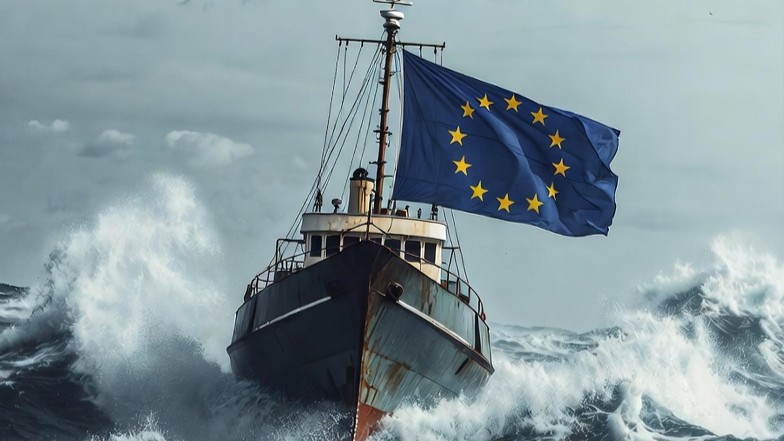
The EU has survived—barely—the pandemic, the war in Ukraine, the break with Russia, and now the threat of an open conflict with Iran. It is surviving, yes. But each time it does so more weakly.
Since 2022, Brussels has repeated that Europe no longer depends on Russian gas. That is true. The problem is that this independence was only partial.
Europe replaced Russian pipelines with liquefied natural gas from the United States, Qatar, and other suppliers. It also moved from depending on a pipeline to depending on an extremely vulnerable global market.
The new critical point is the Strait of Hormuz. Roughly one-fifth of global oil and gas trade passes through it. Europe imports relatively little gas directly from Qatar, but that does not protect it from disruptions there.
If Hormuz is blocked or simply appears unsafe, Asia pays more for each gas cargo and Europe is forced to compete at far higher prices. There is a permanent global market in which oil and gas tankers are effectively auctioned in real time to the highest bidder.
That already happened in 2022. The difference is that, back then, governments still had room for subsidies, public aid, and debt. Today that room is much smaller—or simply no longer exists.
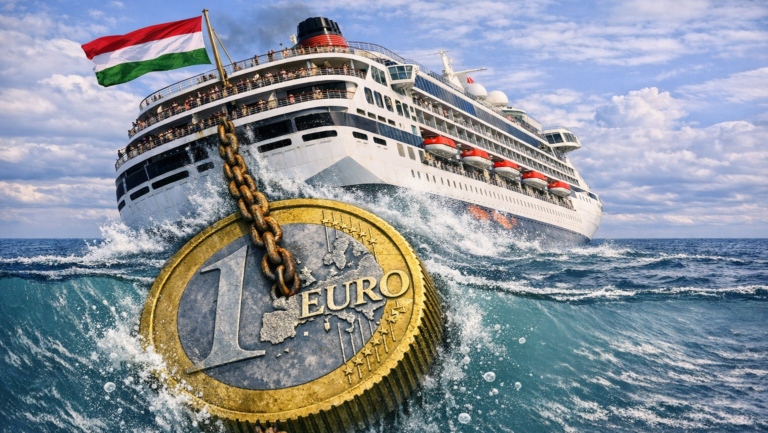
The old fiscal model is gone. Brussels now lives increasingly through ever-rising debt issuance to keep paying the cost of a war in Ukraine that many Europeans no longer believe can continue indefinitely.
Germany has still not recovered its industrial base. France combines deficits, debt ,and permanent political crisis. Italy depends on increasingly nervous financial markets. Governments have less money and societies less patience.
The real question is no longer whether Europe can withstand another energy crisis. The question is whether Europeans are still willing to pay for it. Election results across the continent increasingly suggest that public patience has limits.
Europe’s fragility is not only about energy. The European model was built on three pillars: cheap energy, open trade and American military protection.
All three are now in doubt.
China uses trade as a political instrument, much as Britain did after the Industrial Revolution. The United States does the same. Donald Trump has once again openly questioned America’s expensive security umbrella over Europe. At the same time, the war in Ukraine continues, the Red Sea remains insecure, and the Middle East is once again becoming a threat to global supply chains.
Europe depends on shipping routes, raw materials, and supply chains it does not control. The pandemic already showed that the continent couldn’t even produce masks or medicines without Asia. The same is now true for gas, critical minerals, and defence.
Brussels talks more and more about strategic autonomy. The reality is different.
Europe still depends on the United States for intelligence, air defence, satellites, military transport, and much of its deterrence.
The war in Ukraine forced Europe to increase military spending. The Iran crisis is accelerating that trend. Yet Europe still has no common strategy.
Eastern European countries want to remain under the American umbrella. France wants more autonomy, but under French leadership. Germany is increasing its defence spending while still avoiding any real political or military leadership.
The result is that Europe spends more but remains an incomplete military power.
The Iranian crisis has demonstrated that once again. The European Union did not shape the conflict, could not protect energy routes on its own, and played no decisive role in securing the ceasefire.
Since 2020, Europe has experienced a steady rise in political instability due to inflation, falling living standards, migration, Ukraine, and now the Middle East.
Every external crisis eventually becomes an internal one.
The next ten days will probably be enough to avoid a larger escalation between Israel and Iran. Oil prices may stabilise and the markets may breathe again, but the fragility of the entire European model will not go away.