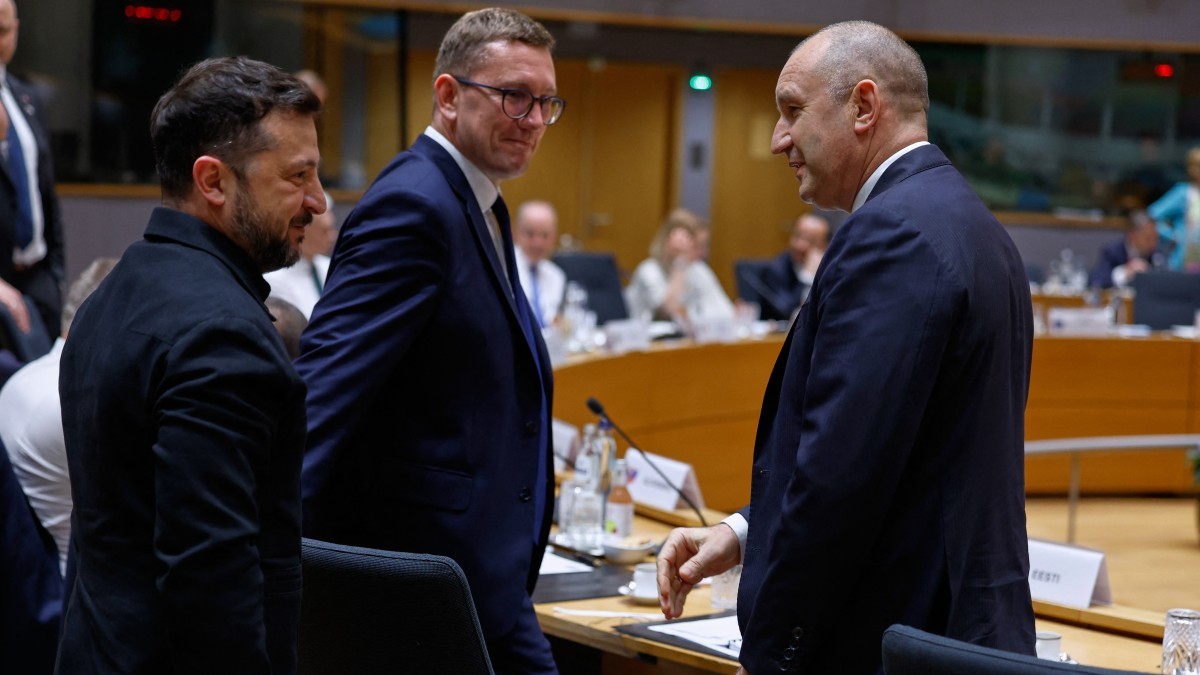
Ukraine’s President Volodymyr Zelensky speaks with Bulgaria’s Prime Minister Rumen Radev (R) as they attend a round table meeting of EU leaders and Ukraine during the EU Summit at the EU headquarters in Brussels, on June 18, 2026.
GEERT VANDEN WIJNGAERT / POOL / AFP
The European Union is facing a new obstacle in its attempt to approve another package of sanctions against Russia. This time, it is not Hungary threatening to use its veto power, but Bulgaria.
Bulgarian Prime Minister Rumen Radev confirmed on Thursday, before travelling to Brussels for the European Council meeting, that his government opposes the new package of measures prepared by the European Commission. The proposal includes sanctions against dozens of individuals and entities linked to Russia’s military-industrial complex, the so-called shadow fleet used to export oil and gas, as well as Patriarch Kirill, the head of the Russian Orthodox Church.
The decision requires unanimity among member states, meaning Sofia’s opposition is enough to block it.
Radev justified his position on both economic and political grounds. First, he warned that some of the measures could affect Bulgaria’s strategic interests, including the operations of Russian oil giant Lukoil, which owns the Burgas refinery, the country’s only major refinery and a key component of Bulgaria’s fuel supply.
The Bulgarian leader also cited potential problems involving the supply of spare parts for the Sofia Metro and difficulties related to fertiliser imports.
However, the most sensitive aspect of the debate revolves around the sanctions against Patriarch Kirill.
“What message are we sending when we extend sanctions and war into the sphere of religion? Do we realise where this leads?”, Radev told reporters.
The prime minister was even more explicit in rejecting the inclusion of the Russian religious leader on the EU blacklist.
“The era of the Crusades is over,” he said. “I am not interested in the Russian Patriarch as an individual. I am interested in the fact that he is the head of the Russian Orthodox Church, which is Eastern Orthodox, just like our church.”
The remarks reflect a particularly sensitive issue in Bulgaria. Although the Bulgarian Orthodox Church and the Russian Orthodox Church are independent institutions, both belong to the Eastern Orthodox tradition and maintain strong historical, cultural and religious ties.
Bulgaria’s opposition comes after Hungary abandoned the position it had maintained for years. In 2022, the government of Viktor Orbán blocked a similar initiative on the grounds of religious freedom. Following the arrival of Péter Magyar’s government, Budapest dropped its objections, prompting Brussels to revive the proposal.
European institutions and several member states argue that Kirill has played an active role in providing ideological legitimacy for Russia’s invasion of Ukraine. Under his leadership, the Russian Orthodox Church has publicly supported the war and promoted narratives portraying the conflict as a spiritual and civilisational mission.
Nevertheless, Sofia considers the measure largely symbolic and potentially counterproductive. Bulgarian Foreign Minister Velislava Petrova-Chamova argued this week that sanctioning the patriarch would have no meaningful economic impact while providing fresh material for anti-Western propaganda.
For now, the dispute has opened a new fault line within the EU after more than four years of war and eighteen rounds of sanctions.