Jean-Luc Mélenchon is gaining ground as France’s 2027 presidential race takes shape, exploiting a divided Left and sluggish centrist campaigns. Still deeply unpopular, the chameleon-like Insoumis leader may yet prove far more dangerous than his current ceiling suggests.
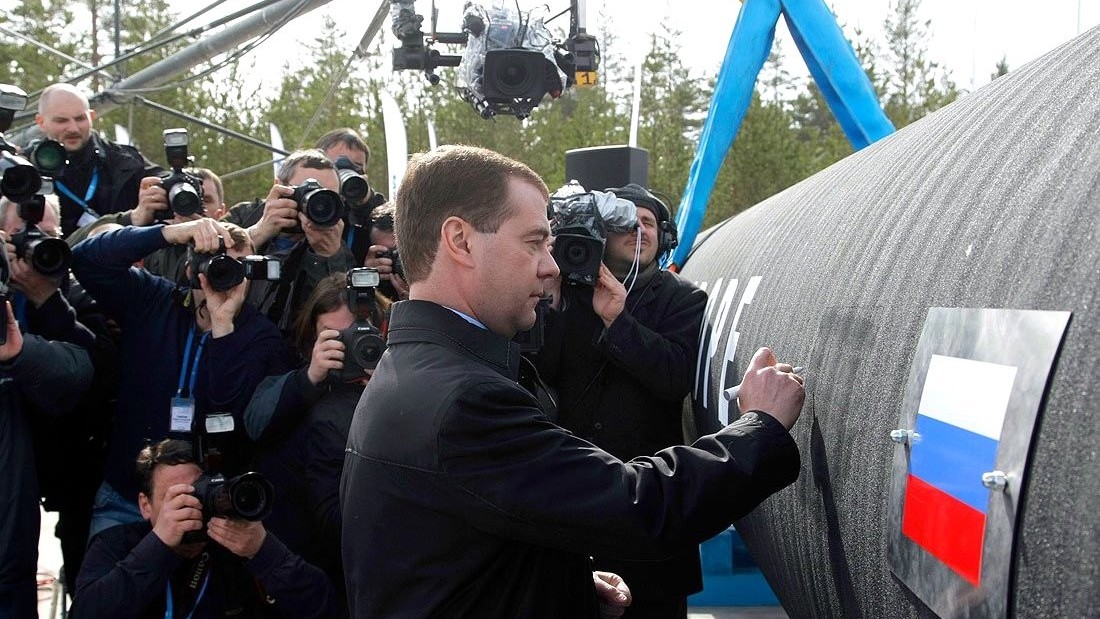
Ceremony marking the start of construction of the Nord Stream gas pipeline’s underwater section with then Russian President Dmitry Medvedev on April 9, 2010
By Kremlin.ru, CC BY 4.0, https://commons.wikimedia.org/w/index.php?curid=9972562
On September 26, 2022, several underwater explosions disabled three of the four Nord Stream pipeline lines in the Baltic Sea. The facts are well known: it was a deliberate act of sabotage against one of the key energy infrastructures linking Russia and Germany.
What remains unresolved, nearly four years later, is responsibility. Or at least officially unresolved.
That vacuum is now being filled by new narratives. The latest comes from journalist Bojan Pancevski, who in his book The Nord Stream Explosion introduces a particularly striking element: the involvement of a Ukrainian woman, a former adult model identified under the pseudonym “Freya,” in the sabotage operation.
According to this reconstruction, “Freya” would have gone from working in Kyiv’s nightlife scene to joining a unit linked to Ukrainian intelligence after the outbreak of the war. Her operational profile is explained by her experience as a diver, a skill that—according to the account—would have been key to placing explosive charges at great depth under highly complex conditions. Pancevski himself describes her as “the bravest diver of the entire group.” How those two worlds fit together is another matter entirely.
There is no official confirmation of these details. Nor are there conclusive denials. What is clear, however, is that as the years pass, the initial hypothesis— Russian responsibility—has given way to a much more fragmented scenario.
During the first months after the attack, much of the political and media discourse in Europe suggested Moscow was behind the sabotage. Russia had the technical capability and the geopolitical context, yes, yet that line of investigation never translated into a formal attribution backed by judicial findings or declassified intelligence.
Since then, other versions have emerged. Journalistic investigations in Germany, such as those by Oliver Schröm and Ulrich Thiele, have pointed to a possible group of Ukrainian operatives with indirect Western support. In parallel, the German judiciary maintains an open investigation in which a single suspect, Ukrainian citizen Serhii K., has been in pre-trial detention since November 2025, accused of sabotage, although he denies any involvement.
The institutional context does not help to close the case either. Sweden and Denmark closed their investigations without definitive public conclusions. Germany continues to investigate, but without a clear official narrative. Meanwhile, Moscow accuses the West; Western governments avoid pointing to conclusive evidence to a specific perpetrator. And that, in geopolitical jargon, has a name: culpability.
It is within that grey area that the story of “Freya” fits. Not as a proven fact, but as a symptom of a broader dispute: the battle over the narrative.
Because Nord Stream was not just an energy infrastructure. It was—and remains—a geopolitical vector. In fact, it is a casus belli for Germany, though not against Russia, but against Ukraine.
More broadly, its destruction accelerated the energy rupture between Europe and Russia, consolidated the shift toward alternative suppliers and reinforced strategic dependence on other actors. The economic impact is also measurable: the definitive cut of Russian gas supply through that route drove up industrial and energy costs across the European Union in the months that followed.