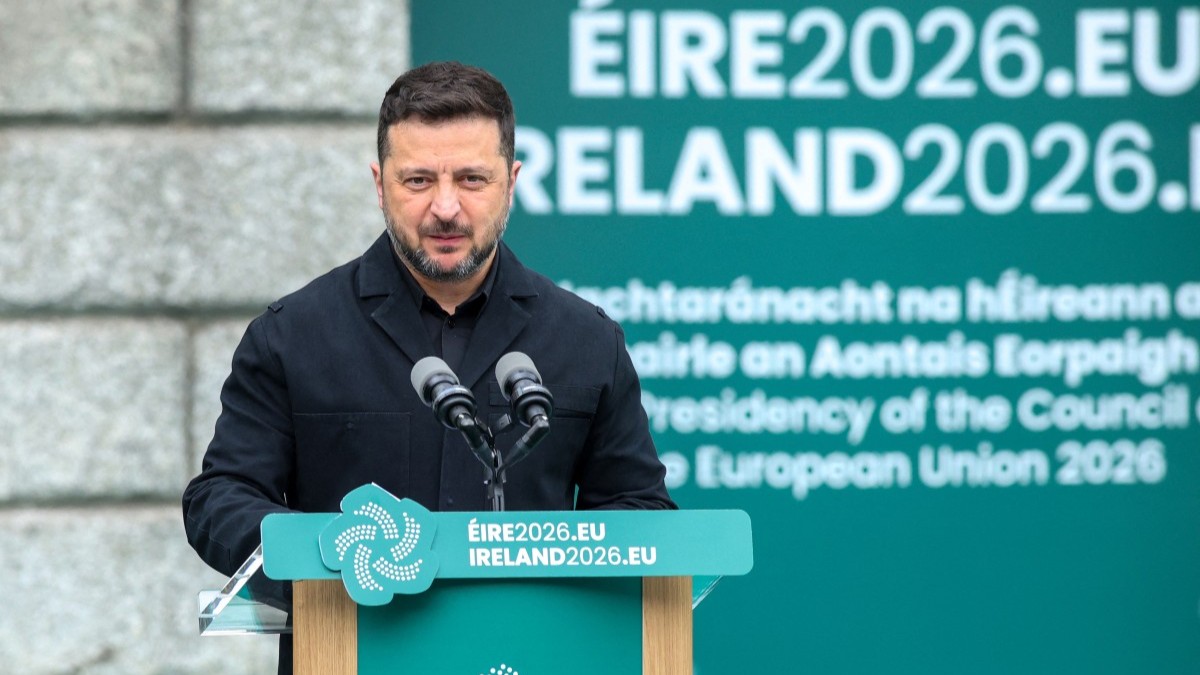
Ukraine’s President Volodymyr Zelensky speaks during a formal ceremony to mark the launch of Ireland’s eighth EU presidency, at Dublin Castle in Dublin on July 1, 2026.
PAUL FAITH / AFP
Volodymyr Zelensky arrived in Dublin on Wednesday with the same message as always: more sanctions against Russia, more financial support, and more speed in bringing Ukraine into the European Union.
The Ukrainian president used the start of Ireland’s presidency of the Council of the EU to demand that Brussels maintain the momentum behind accession and open new negotiating chapters before the end of the Irish presidency.
I thank all European leaders for opening the first negotiation cluster in Ukraine’s EU accession talks. And it was an important decision during the Cyprus Presidency. Now we must keep moving forward without losing time. We can open 5 more clusters very soon and continue the… pic.twitter.com/Fr5DwwgupB
— Volodymyr Zelenskyy / Володимир Зеленський (@ZelenskyyUa) July 1, 2026
The request is not surprising; what has changed is the context.
Ukraine is no longer asking for help only as an invaded country. It is asking for political integration, structural money, and entry into the institutional core of Europe while it remains under martial law, without national elections, and with an economy sustained by external support. The war explains many things, but it does not erase the trail of certain facts.
On June 15th, the EU opened the first negotiating cluster with Kyiv, the ‘fundamentals’ cluster: rule of law, democratic institutions, public procurement, justice, fundamental rights, and financial control. It is precisely the block that should measure whether a state is prepared to enter the Union. In Ukraine, however, that examination is being conducted while the country operates under an exceptional regime.
Added to this is the economic aid. The Council has finalized a €90 billion loan to cover budgetary and defense needs between 2026 and 2027. Brussels talks about conditions, controls, and the fight against corruption, but the problem does not lie in the institutional language; it lies in the harsh reality. Ukraine is a state at war, with billions entering through extraordinary channels, with inevitable military opacity, and with a political elite that depends on keeping the machinery running.
Corruption, in that context, is almost a consequence. It needs opportunity, urgency, and money. Ukraine has all three.
The Nord Stream case now adds a political burden that had been surprisingly omitted in recent years. Germany has filed charges against a Ukrainian citizen, Serhii K., over his alleged participation in the blowing up of the pipelines in September 2022. According to the German indictment, the suspect allegedly coordinated an operation against civilian energy infrastructure. He denies it. The courts will have to prove it.
The simple fact that Berlin has crossed that threshold is already important. Germany is not speaking as a spectator, but as an affected state—one that also generated a domino effect across the entire continent. For years, Nord Stream has been an open wound beneath a layer of diplomatic silence.
Now it seems that this silence is coming to an end, and that could change everything.
Germany has been Ukraine’s great European financier, the country that assumed a central part of the energy cost of the rupture with Russia, and one of the pillars of military support for Kyiv. If German justice ultimately proves that Ukrainian citizens, or structures linked to Ukraine, participated in the sabotage of critical German infrastructure, the problem will be political.
As the war drags on, money keeps evaporating in Kyiv’s hands. Ukrainian dead are piling up by the hundreds of thousands. Accession is accelerating. And Nord Stream is back.
None of this absolves Russia of the invasion. Moscow started the war and remains responsible for it. But Europe cannot turn that truth into an alibi to avoid asking questions about Ukraine, about its elites, and about the price of integrating it at full speed.