MCC Brussels
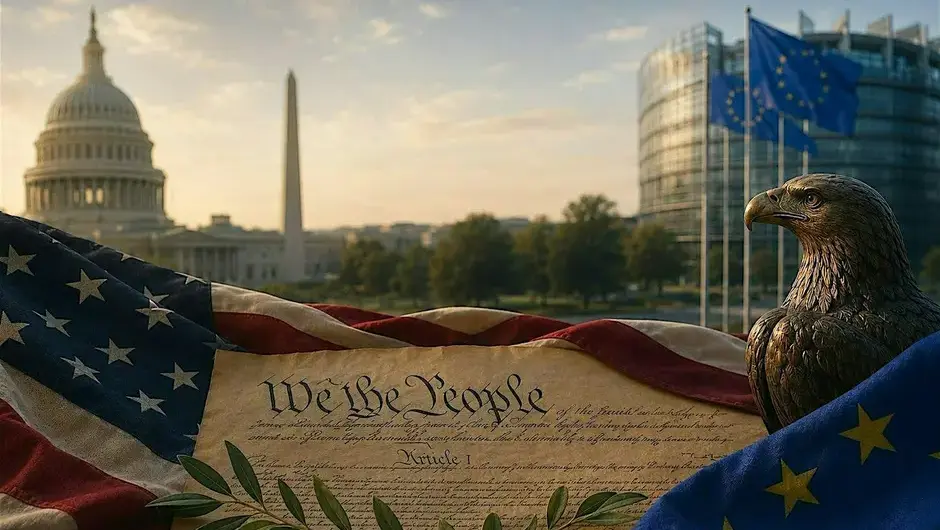
What remains today of the spirit that gave birth to the United States 250 years ago? Does a shared Western civilization still exist, or are Europe and America beginning to follow different paths?
These were some of the questions at the heart of a special event organized this Wednesday by MCC Brussels to mark the 250th anniversary of the American Declaration of Independence.
Across three panels and several hours of debate, historians, philosophers, academics, diplomats, and political figures examined not only the legacy of the American Revolution but also the current state of an increasingly complex transatlantic relationship.
Far from focusing solely on contemporary politics, much of the discussion revolved around the idea that the United States is not a break from Europe but rather an extension of intellectual, legal, and cultural traditions born in Athens, Rome, Jerusalem, and Christian Europe. According to several participants, this shared heritage remains the foundation of what has historically been called Western civilization, even if it can no longer be understood as a geographically bounded space.
MCC Brussels Executive Director Frank Furedi opened the event by recalling that the Declaration of Independence served as a source of inspiration for numerous European political movements for decades. He cited the Hungarian, Polish, Greek, and Belgian revolutions as examples of movements that saw in that document a universal defense of political liberty. Furedi also lamented the decline of concepts such as “self-evident truths” and “common sense,” which he argued were essential elements in the construction of Western democracies.
"One of the great things about a friendship is that you don't always have to explain yourself."@Furedibyte observation illuminates today's transatlantic divide. Friendships depend on shared assumptions-things so fundamental they seem self-evident.
— MCC Brussels (@MCC_Brussels) June 10, 2026
Jefferson could write of… pic.twitter.com/tM5dZfrD8Q
The first panel brought together Francesco Giubilei, James Hankins, Rita Koganzon, and Albrecht Rothacher to examine the American contribution to Western civilization. Rejecting the notion that the United States emerged as a completely new creation, several speakers stressed that the Founding Fathers drew directly from the European classical tradition. Hankins argued that the U.S. Constitution did not emerge out of nowhere but was the product of a long intellectual conversation incorporating elements from Greece, Rome, medieval Christianity, and modern European political experience.
Giubilei went even further, describing Washington as the fourth great pillar of the West alongside Athens, Rome, and Jerusalem. According to the Italian intellectual, the American Revolution represented a “conservative revolution” insofar as it sought to preserve inherited liberties rather than destroy the existing order, in contrast to the French experience.
The debate took on a far more controversial tone during the second session, which focused on the possibility of a civilizational split between Europe and the United States.
Matthew Crawford, of the Institute for Advanced Studies in Culture at the University of Virginia, argued that both Europe and America now face common challenges linked to the erosion of democratic sovereignty, the expansion of technocratic structures, and the growing power of major technology platforms. Anatol Lieven, meanwhile, rejected the idea of a simple divide between Europe and America and argued that the deepest fractures run through Western societies themselves.
The most provocative intervention probably came from Thibaut Mercier, president of Cercle Droit et Liberté, who directly questioned the very existence of a homogeneous Western civilization and argued that Europe and the United States have been following distinct trajectories for centuries.
Opposing that view, Peter Wood, president of the National Association of Scholars, argued that the current divergence is primarily the result of decisions adopted by European elites in areas such as immigration, cultural identity, and freedom of expression. This point was also debated later by members of the audience, who noted that many of those policies were first developed on American soil.
The final panel shifted the discussion into the geopolitical realm, where the tensions currently shaping the transatlantic relationship became particularly clear.
Dutch MEP Marieke Ehlers, American consultant Matt Mowers, and Spanish MEP Hermann Tertsch agreed that Europe and the United States will continue to need each other but differed on the extent to which their national interests still converge. Energy, defense, immigration, sovereignty, and digital regulation repeatedly emerged as areas where priorities are beginning to diverge.
Even so, one idea ran through almost the entire day: the relationship between Europe and the United States resembles less a temporary alliance than a family relationship. At times they cooperate, at times they compete. They share historical roots, values, and intellectual traditions, but they also face increasingly visible disagreements over how those same principles should be interpreted in the twenty-first century.
Perhaps that is why the real debate was not only about the past of the American Revolution but about the future of the West itself—a West that no longer faces only external rivals but also internal questions concerning identity, sovereignty, democracy, and historical continuity.
Two and a half centuries after 1776, the question raised in Brussels seemed less historical than political: if Europe and the United States still belong to the same civilization, will they still be able to recognize themselves in one another in the decades ahead?