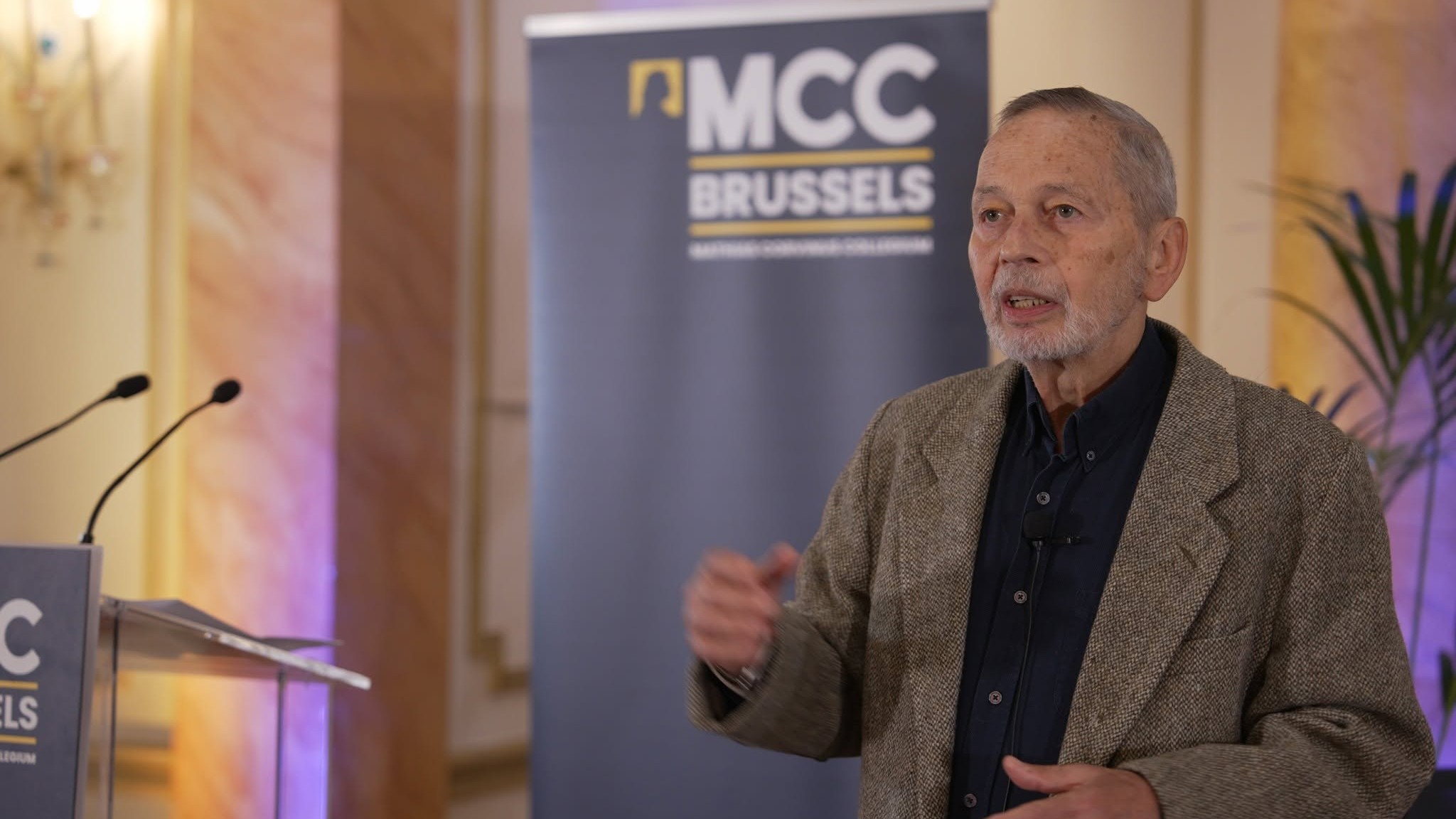
MCC Brussels Executive Director Frank Furedi
MCC Brussels on Facebook, June 11, 2026
The European Union’s Transparency Register has suspended the registration of MCC Brussels, one of the most active conservative think tanks in the European capital, a decision that makes it more difficult for the organization to access certain activities and institutional mechanisms linked to EU institutions.
The organization announced on Monday, June 15th, that it would appeal the measure and accused the Transparency Register Secretariat of applying political criteria under the guise of an administrative matter.
According to MCC Brussels, the suspension is not related to allegations of financial irregularities, undisclosed meetings, hidden lobbying activities, or breaches of transparency obligations. Instead, the dispute centers on the interpretation of the so-called single registration principle, a rule designed to prevent the same network or organization from operating through multiple separate registrations.
The Register’s own guidelines state that organizations with branches, chapters, or structures operating in several countries should register only once in order to cover all of their activities. The issue now under discussion is whether MCC Brussels should be considered an autonomous entity registered under Belgian law or part of a broader structure linked to Mathias Corvinus Collegium in Hungary.
In its statement, the organization argues that it cooperated with the Secretariat for more than a year, responding to every request for information and clarification made during the investigation. Nevertheless, it maintains that the final decision was based on a disputed interpretation of the rules rather than on any substantive breach of transparency obligations.
MCC Brussels Executive Director Frank Furedi said the suspension forms part of a broader pattern of attempts to marginalize conservative collectives within Brussels’ political ecosystem. Furedi insists
This decision is not simply about an administrative disagreement. For four years MCC Brussels has faced relentless attempts to isolate and silence our work because we challenge prevailing orthodoxies.
The institution also points to previous incidents, including attempts to cancel public events, pressure campaigns targeting venues hosting its conferences, and the intervention of several Brussels mayors who sought to halt the National Conservatism Conference in April 2024, a decision that was later overturned by Belgian courts.
One of MCC Brussels’ central arguments is what it describes as the unequal application of the rules.
The think tank says it highlighted during the proceedings the existence of multiple active registrations within the World Wide Fund for Nature (WWF) network. According to MCC Brussels, the Secretariat acknowledged that it is examining similar situations involving WWF. Yet, while registrations linked to that organization remain active, MCC Brussels has been suspended.
For the think tank, this difference in treatment raises questions about whether the rules are being applied consistently or whether certain organizations are subjected to greater scrutiny because of their ideological positions.
The controversy is particularly significant because the Transparency Register presents itself as a tool designed to guarantee institutional openness and equal access.
Official guidelines state that the register is a public database created to identify interest representatives seeking to influence European policymaking and decision-making. They also make clear that registration does not imply any form of political recognition by the institutions and that the rules should be applied uniformly to all actors.
At the same time, the system has become a practical requirement for numerous institutional activities. The European Commission requires registration for certain meetings with commissioners and senior officials, while the European Parliament uses it for various forms of accreditation and public participation.
For that reason, although it is formally presented as an administrative matter, the suspension carries clear political consequences.