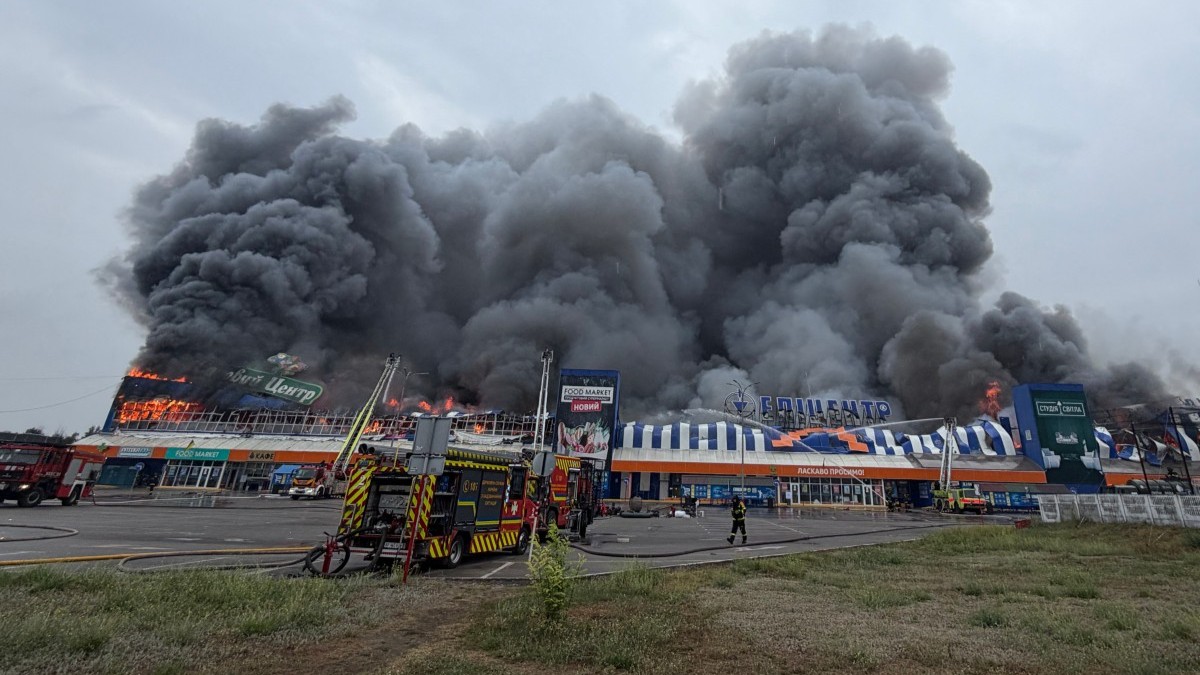
Ukrainian rescue personnel work to extinguish a fire in a damaged shopping mall following a Russian air attack in Zaporizhzhia on August 28, 2026.
DARYA NAZAROVA / AFP
Russia appears to have moved beyond the phase of relative restraint it had maintained in recent weeks while waiting to see how far Washington was prepared to go to limit Ukrainian escalation.
The U.S. answer, judging by what has happened since CIA Director John Ratcliffe visited Moscow on August 25th, does not appear to have convinced the Kremlin.
In the days that followed, Russia significantly intensified its campaign against Ukraine. Kyiv and other regions have endured prolonged waves of drone and missile strikes, while Moscow has simultaneously increased pressure on energy infrastructure, logistical corridors and Ukrainian defensive positions in the Donbas.
Last weekend, Russian forces launched more than 550 drones. Moscow is combining attack drones, decoys, ballistic missiles and cruise missiles in an attempt to saturate Ukrainian air defences and increase the economic cost of sustaining the war.
Ground pressure is also increasing around Sloviansk and Kostiantynivka, central elements of Ukraine’s fortified belt in Donetsk. Artillery, glide bombs and drones are being used to wear down positions ahead of larger ground operations.
This does not yet amount to a breakthrough on the front. Russian advances remain slow in several sectors, but the important change lies in the scale and nature of the pressure: Moscow seems to have concluded that it no longer has sufficient incentives to preserve its previous level of restraint.
That shift coincides with Ratcliffe’s extraordinary visit to Moscow to meet senior Russian intelligence officials. He did not meet Vladimir Putin directly, although the Kremlin confirmed that the president was later briefed on the substance of the discussions.
According to available reports, Washington raised three main concerns: the course of the war in Ukraine, the risk that escalation could eventually affect NATO countries—particularly the Baltic states—, and the growing military cooperation between Russia and Iran.
The latter has acquired particular importance because of developments in the Middle East and Washington’s well-known intention to link the two conflicts.
Iran supplied Russia with drones and technology for use in Ukraine for years. Washington now fears that the relationship could also work in the opposite direction, with Moscow providing Tehran with military assistance, intelligence or capabilities that could strengthen its position against the United States and Israel.
Ratcliffe’s visit therefore had a dimension extending well beyond Ukraine. It was an attempt to establish red lines between two powers engaged in several simultaneous theatres of confrontation.
The visit also allowed Moscow to measure the American position directly.
During Ratcliffe’s stay, Washington reportedly asked Kyiv to avoid long-range strikes against Moscow, St. Petersburg and certain Russian regions. The request was likely strictly tactical: preventing a Ukrainian operation from interfering with the CIA director’s mission. In other words, not as a gesture of goodwill, but to ensure that the noise did not obscure Washington’s attempts to gain the upper hand.
This is probably one of the keys to the Russian interpretation.
Moscow had been pressing the United States for some time to clarify how far it was prepared to allow Ukrainian deep strikes inside Russian territory. The Kremlin had continued to leave open the possibility that Washington might use its influence over Kyiv to restrain certain operations.
There is no public evidence that Ratcliffe explicitly told Moscow that the United States refuses to control Ukraine, but nor are there indications that the meeting produced any new structural restrictions on Kyiv.
From the Russian perspective, that absence may itself have served as an answer: Washington is only prepared to limit certain attacks temporarily to protect a diplomatic mission, but does not alter Ukraine’s operational freedom over the longer term. Moscow’s reaction suggests the Kremlin has concluded there is little point in continuing to wait for gestures of de-escalation.
Russia has thus expanded its attacks, intensified pressure on the Ukrainian economy, and once again raised the cost of the war for Kyiv and its allies, with the Europeans having already committed €220 billion in assistance.
Speaking of “total war” remains technically excessive. Russia retains capabilities that it is still not using to their full extent and continues to avoid a confrontation with NATO, even as some member states increasingly regard a military conflict as inevitable sooner or later, as is the case in Germany.
Moscow’s message is becoming increasingly unambiguous: if Washington is not prepared to limit Kyiv, Russia will use a greater share of its military capabilities to impose those limits by force.