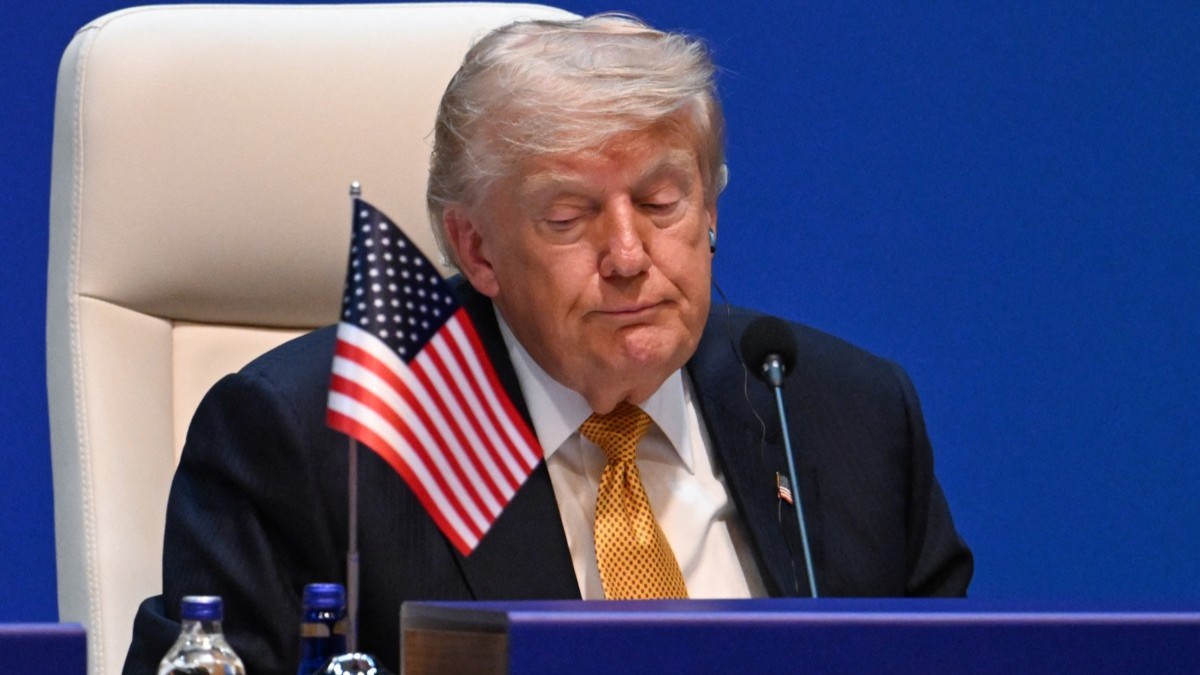
U.S. President Donald Trump participates in a NATO Leaders’ working session during the NATO Summit at Bestepe Presidential Compound in Ankara, Turkey, on July 8, 2026.
ALEXIS JUMEAU / POOL / AFP
The NATO summit in Ankara was supposed to display unity. Instead, it exposed a level of tension far greater than expected.
With the war in Ukraine showing no signs of ending in the short term, the northern flank under Russian pressure, and the Iran war still ongoing—Washington was bombing the country during the summit—Donald Trump arrived in Turkey with the message that the United States remains inside the Alliance, but it will no longer accept paying the political and military bill without strategic obedience in return. In other words: submission.
The U.S. president did not choose a diplomatic tone. He targeted Spain, put Greenland back on the table, and reproached several European allies for failing to back the American offensive against Iran. Ankara was meant to be the summit of the 5% of GDP defence spending target by 2035. To a large extent, it became a session of Atlantic discipline to which many are no longer accustomed.
The harshest attack was aimed at Madrid. Trump described Spain as a “lost cause” and called for cutting “all trade” with the country, “including visits.” “Spain is a terrible partner in NATO. They don’t participate, they don’t pay. I don’t want anything to do with Spain. Cut all trade with Spain, please, including visits … We don’t want anything to do with them,” he told reporters alongside NATO Secretary-General Mark Rutte. He added that Spain was “beyond repair” and that he did not want to “do business” with it.
.@POTUS: "Spain is a wasted cause. We don't want to do any trade business with Spain anymore by the way… Spain is a terrible partner in NATO. They don't participate, they don't pay. I don't want anything to do with Spain." pic.twitter.com/3prqux6p54
— Rapid Response 47 (@RapidResponse47) July 8, 2026
The European Commission responded from Brussels by trying to close ranks. EU trade spokesman Olof Gill recalled that the EU “will always ensure that the interests of the European Union and its Member States are fully protected” and urged Washington to respect the transatlantic trade agreement, which sets a 15% tariff on most European products. The reaction was predictable: trade policy does not belong to Madrid, but to Brussels. Trump attacked Spain, but he touched on a Union competence.
Rutte tried to lower the temperature. He reminded Trump that Spain had already reached 2% of GDP in defence spending and argued that U.S. disappointment over Iran concerned only “isolated cases.” According to the secretary-general, Europe continued to function as “a major platform for projecting power for the United States,” with around 5,000 U.S. sorties conducted by U.S. forces from European bases and bilateral agreements governing base access still in force.
But the problem was not Spain alone. Trump reproached the United Kingdom, Germany, Italy, and France for not helping Washington during the military operation against Iran. “I was sort of testing people, to see whether they would be there,” he said. The phrase sums up the new climate within the alliance: the American guarantee is no longer presented as an automatic commitment, but is beginning to function as a permanent test of loyalty.
The other front was Denmark. Trump again defended the idea that Greenland should be under U.S. control, reopening a wound that Copenhagen considers closed. Danish Prime Minister Mette Frederiksen replied that Greenland “is not for sale” and called for respect for the sovereignty and territorial integrity of the Kingdom of Denmark. Iceland, the Netherlands, and Latvia backed Copenhagen, while several European allies announced increased cooperation in the North Atlantic, the Arctic, and the Baltic Sea.
🇺🇸 NATO’s Rutte on whether Trump's talk of taking Greenland and pulling troops out of Europe is serious, or if he's still a committed team player:
— Mario Nawfal (@MarioNawfal) July 8, 2026
"He is completely committed."
Full commitment, Greenland asterisk pending.
Writer: Juliepic.twitter.com/WF6gRCsdUu https://t.co/tdP4D7ZIY5
Europe accepts higher spending, greater responsibility, and a reinforced northern flank. But Washington is not only demanding more money. It is demanding political alignment. Rutte calls it “NATO 3.0.” Trump has turned it into something else: an alliance where the protector returns to the classroom to scold the rest of the pupils.
The question arises: can an alliance speak of unity when its leading power treats some partners like delinquent debtors and others like negotiable territories?