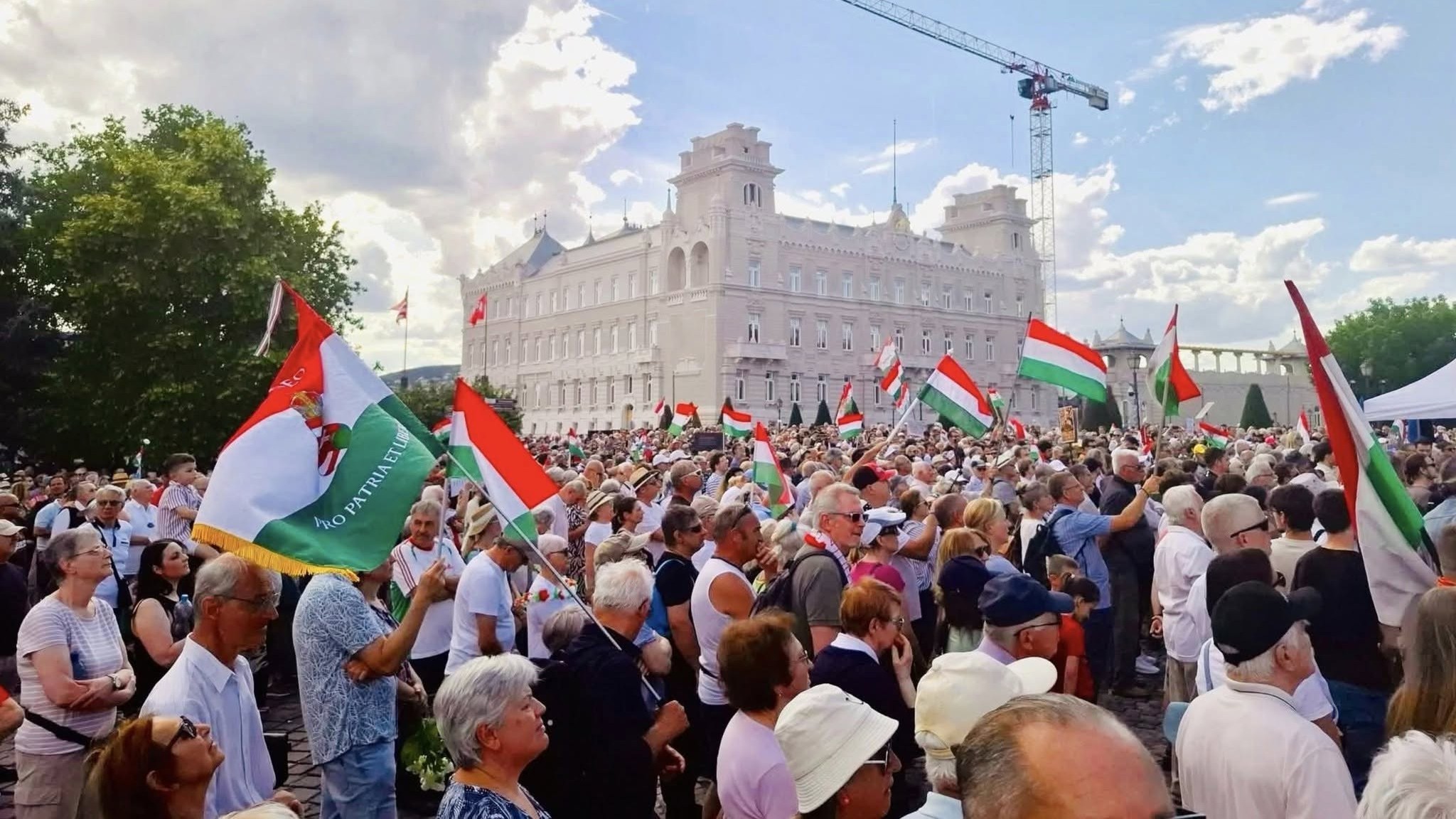
Public opposition to new Hungarian Prime Minister Péter Magyar’s government intensified over the weekend as thousands of demonstrators took to the streets of Budapest to protest the European Union’s Migration and Asylum Pact and the government’s efforts to purge state institutions.
A demonstration on Friday, June 5th, focused on concerns that Hungary could be forced to participate in the redistribution of migrants under the EU’s new migration framework, which enters into force on June 12.
🚨SHOCKING:
— Based Hungary 🇭🇺 (@HungaryBased) June 6, 2026
🇭🇺 Thousands of Hungarians take to the streets to Protest Magyar Péter's Deals Over the Migration Pact.
"In Referendum we already said "NO" to Illegal Migration in 2016." pic.twitter.com/L3lzCEhGie
The pact—rejected by Hungary under the previous, Viktor Orbán-led conservative government, but approved in 2024 by majority voting in the EU—introduces a “solidarity mechanism” under which member states facing migratory pressure may receive assistance from other EU countries.
Such assistance can include the relocation of asylum seekers or alternative financial and operational contributions.
European right-wing and conservative critics of the pact have long argued that the agreement fails to address the root causes of migration and instead institutionalises the redistribution of migrants across the EU.
According to László Toroczkai, the leader of the Hungarian right-wing opposition Mi Hazánk Mozgalom (Our Homeland Movement),
the implementation of the Migration Pact will certainly be forced upon Hungary. Either migrants will have to be accepted, or we will have to contribute with money and personnel to Europe’s migration system.
Toroczkai accused the prime minister of inadvertently revealing a connection between the pact and the recently announced unlocking of frozen EU funds for Hungary. Magyar effectively admitted this link when he claimed that demonstrators were protesting against the release of approximately €16 billion in EU funds.
Critics have long suspected that further concessions on migration policy could form part of the new government’s bid to improve relations with EU institutions—relations which had been strained under Orbán’s tenure due to his government’s anti-migration, anti-LGBT, and anti-war stance.
Balázs Orbán, the former prime minister’s adviser, issued a stark warning about the long-term implications of the pact. “Think about what impact this could have on Hungary ten years from now,” he wrote on Saturday on social media.
He argued that Hungary could eventually be required either to accept migrants assigned through EU solidarity mechanisms or pay 7 million forints (€20,000) for each migrant not accepted. He also warned that, in crisis situations, Brussels could increase the number of migrants to be redistributed among member states and further expand its influence over migration policy.
He also warned that national authorities would face growing restrictions when attempting to deport asylum seekers.
Former Prime Minister Viktor Orbán has also called on the new government to declare immediately that Hungary will not implement the pact when it enters into force at the end of this week.
The migration dispute is unfolding alongside a separate constitutional confrontation between the government and President Tamás Sulyok.
On Sunday, June 7th, a large sympathy rally was held outside the Sándor Palace, the president’s office, in support of Sulyok and other public officials whom the government has sought to remove from office. Speakers warned that the rule of law is being dismantled, and that Magyar’s maneuvers amount to the “return of bolshevism.”
Both demonstrations were organised by right-wing conservative civil groups, but several Fidesz and Mi Hazánk politicians showed up as well.
Having entered office only a month ago, Péter Magyar’s centrist government is already facing growing frustration over his efforts to roll back his predecessor’s sovereigntist and conservative policies in a bid to appease Brussels.