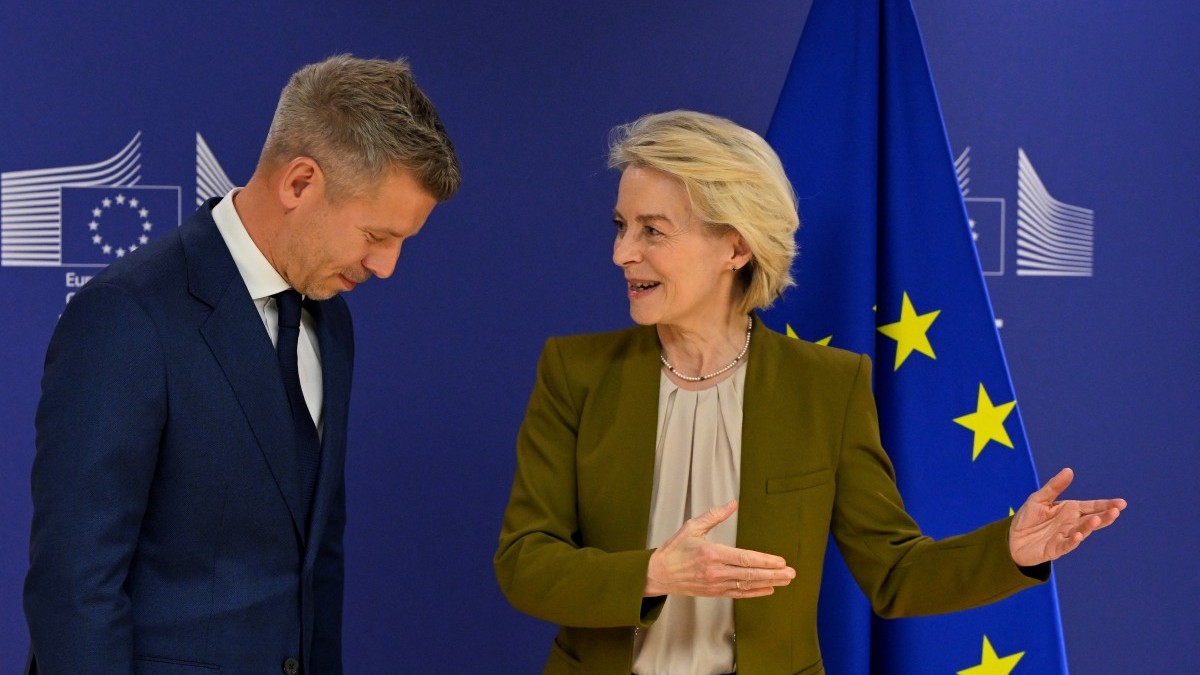
Péter Magyar has already taken the first step in what appears to be the dismantling of Orbán’s key policies. On Wednesday, April 29th, the new Hungarian leader travelled to Brussels o to meet with the president of the European Commission, Ursula von der Leyen, and the president of the European Council, António Costa.
The formal objective was to clear the political path toward unlocking European funds that had been frozen for Hungary for years.
After the meeting, Magyar himself described it as “constructive and productive” and confirmed that he will return to Brussels in the week of May 25 to conclude the necessary political agreement. At the same time, von der Leyen publicly set the framework: the funds remain frozen due to “concerns about corruption and the rule of law,” and the Commission will “support” the steps Hungary takes to “realign with shared European values.”
That is the starting point. In other words: the only path forward is the one demanded by the Commission.
The institutional context, however, is somewhat more complex.
Hungary has more than €10 billion blocked under the Recovery and Resilience Facility. Access to those funds is conditional on a list of milestones—21 in total—including judicial reforms, anti-corruption measures, and regulatory adjustments. Viktor Orbán’s government met some of those conditions but, in the Commission’s eyes, not enough to unlock the financial flow.
According to Orbán’s administration, it did not matter what was fulfilled. There were always more demands on the table. What changes now is not the mechanism, but the Hungarian interlocutor.
Within days, Brussels has shifted from a relationship of structural confrontation with Budapest to a phase of accelerated political negotiation. The implicit message is that there is room to unlock funds but not without trade-offs. And those trade-offs are not merely technical.
According to EU sources, the Commission is prioritising three areas: alignment with the common policy on Ukraine, adaptation to the EU migration framework, and revision of legislation linked to fundamental rights. This is not new in itself, but the timing is. Everything is being activated now, with a new government not even sworn in yet.
It is telling that von der Leyen did not speak of negotiation, but of “necessary steps.” And she stressed the idea of “realignment.” Words matter, and what she expressed implies that the relationship does not start from zero, but from a prior deviation that must be corrected.
Magyar, for his part, has not yet specified the content of those concessions. His communication has been deliberately ambiguous. He speaks of agreement, cooperation, and a return to the European centre. But he avoids specifics. He knows that any sign of submission to Brussels without something in return will be seen as a defeat by his electorate.
The calendar adds extra pressure. The Commission expects rapid progress to justify a partial unfreezing of funds before the summer (that is less than three months away). Magyar needs those resources to stabilise his government. It is a negotiation with aligned incentives, but asymmetric political costs.
The May meeting will be the next critical point. There will be no more generic statements there. What remains in the air is whether there will be concrete commitments.
For now, the movement is clear. Magyar has entered the European institutional circuit without friction. And Brussels has responded by opening the door.
The price of crossing it has yet to be set.